To increase the chance Google cites your page in an AI Overview, first make your page technically crawlable, then rewrite key sections so the first sentence directly answers the likely question. Add Article and FAQPage schema where it matches your visible content, strengthen your author and brand signals, and track a “citation rate” across a fixed set of prompts. Everything below breaks that verdict into a plan you can start this week and finish this quarter.
TL;DR:
- Pages must be technically crawlable, properly indexed, and load content server-side to be considered for AI Overviews citations.
- Answer key questions directly in the first sentence of each section using question-based headings to improve extractability.
- Schema markup, especially FAQPage and Article types, should accurately reflect the visible content to support AI extraction efforts.
- A high citation rate depends on content that thoroughly answers related subquestions and includes named facts, dates, or figures, not broad coverage.
- Tracking citation rate with fixed prompts and improving author and brand signals through credible, original data enhances chances of being cited in AI responses.
Table of Contents
- What Signals Determine AI Overviews Optimization Success?
- Technical Checklist: Make Your Content Discoverable and Extractable
- How to Write Pages AI Will Prefer
- Practical Schema to Add (and Common Pitfalls to Avoid)
- How to Track AI Overview Citations and Measure Impact
- Concrete E-E-A-T Actions That Actually Move Citations
- A Prioritized Action Plan You Can Run This Quarter
- Challenges and Limitations in AI Optimization
- Case Studies and Practical Examples of AI Optimization in Action
- Types of AI Models Commonly Optimized For
- Performance Metrics That Actually Matter Here
- Ethical Considerations and Biases in AI Optimization
- Mistakes to Avoid and Realistic Timelines
- Where Courimo Fits When You Need Implementation Help
- Primary References and Tools Cited in This Guide
- Sources
- FAQ
What Signals Determine AI Overviews Optimization Success?
AI Overviews don’t rank pages the way classic search does. They synthesize an answer from a handful of sources, then decide which ones earn a visible citation. Organic position still matters, but it’s a floor, not a guarantee. Google’s own guidance on generative AI features confirms that the core SEO fundamentals, technical accessibility, unique content, and a people-first approach still drive whether a page even qualifies for consideration.
Ranking well and getting cited are two different games. A page sitting at position 3 can get skipped entirely if a competitor’s page at position 7 has a cleaner, more extractable answer sitting in the first two sentences of a relevant section.
Here’s what actually separates cited pages from ignored ones:
- Extractable passages beat broad coverage. A tightly worded, self-contained answer of one or two sentences is easier for the model to lift and attribute than a paragraph that meanders toward its point.
- Query fan-out coverage wins multi-source slots. Search Engine Land’s practitioner guide notes that AI Overviews often assemble an answer from several sources, meaning a single page that thoroughly answers the main question and its related subquestions has a real shot at being one of the sources selected.
- Brand mentions carry a multiplier effect. Pages from sites the model has already encountered favorably, through citations, structured data, or consistent topical coverage, tend to get pulled more often than a first-time source saying the same thing.
- Freshness and factual specificity tip close calls. Content updated or republished within the past year, and passages that include named facts, dates, or figures instead of vague generalities, tend to win the tiebreaker between two otherwise similar sources.
The scale of what’s at stake here is worth sitting with. By mid-2026, roughly 48% of search queries trigger some kind of AI-generated response, according to HubSpot. That means nearly half the traffic you’re competing for now runs through a synthesis layer before a searcher ever sees a traditional blue link.
Search Engine Land also documents that AI Overviews typically cite between four and eight supporting pages per response. That’s a wider door than a single “position one” slot, but it also means you’re competing against more simultaneous winners, not fewer. Your job isn’t to beat one competitor. It’s to be one of several sources clear enough to survive the synthesis process.
Technical Checklist: Make Your Content Discoverable and Extractable
None of the writing tactics below matter if Google’s crawlers can’t reach or render your content in the first place. Technical eligibility is the gate everything else walks through.
- Verify indexing status first. Confirm your key pages are indexed and not blocked by an errant robots.txt rule or a stray noindex tag. Google Search Console’s coverage tools will show you exactly which URLs are excluded and why.
- Submit and maintain a clean XML sitemap. Outdated or bloated sitemaps waste crawl budget on pages that don’t matter and can bury the ones that do.
- Render your main content server-side. If your key answer text loads only after a client-side JavaScript render, some crawlers may never see it. Server-side rendering or pre-rendered HTML removes that risk entirely.
- Hit reasonable Core Web Vitals targets. Slow-loading pages get crawled less frequently and, in some cases, get abandoned mid-render, which means the crawler may capture an incomplete version of your page.
- Check your server logs for crawler activity. Confirm that legitimate AI and search crawlers are actually reaching your priority pages, and that no overzealous firewall rule or CDN setting is quietly blocking them.
- Audit for accidental blocks. A “temporary” noindex tag from a staging deployment, a disallow rule copied from an old robots.txt, or a Cloudflare bot-fight setting can all silently remove you from consideration.
The unique-content and technical-accessibility principles here aren’t new. Google Search Central has said for years that core SEO best practices remain the foundation for these newer AI features. If your technical SEO is already sound, this section is a quick audit, not a rebuild. If you’ve been coasting on a JavaScript-heavy front end without checking how it renders to crawlers, rethinking your site’s rendering approach should move up your priority list.
Pro Tip: Pull your server logs and filter for known crawler user agents before you touch a single line of content. A perfectly written answer sitting behind a rendering issue is invisible no matter how good the prose is.
Once the technical layer is confirmed clean, a standard site audit and optimization pass is the fastest way to catch smaller issues, duplicate meta tags, orphaned pages, thin category templates, that quietly suppress crawl efficiency without throwing an obvious error.
How to Write Pages AI Will Prefer
The single highest-leverage content change you can make is answering the question in the first sentence of every relevant section. Not the third sentence. Not after a throat-clearing paragraph about why the topic matters. The first sentence.
This works because of how these systems extract passages. A model scanning your page for a usable answer isn’t reading it the way a human does, start to finish, absorbing context as it goes. It’s looking for a self-contained chunk of text that answers a specific question cleanly enough to quote or paraphrase without additional editing. Search Engine Land’s guidance backs this directly: placing a clear, factual definition sentence at the start of a section measurably improves how often that passage gets pulled.
Four formatting habits make the biggest difference:
- Write question-format headings. “What is X?” or “How does Y work?” as an H2 or H3 tells both the reader and the model exactly what the following text answers.
- Answer in the first one to two sentences under that heading. Save the nuance, caveats, and examples for the sentences that follow.
- Keep sentences under 20 words where possible, and paragraphs to two to four sentences. Long, clause-heavy sentences are harder for extraction models to isolate cleanly.
- Front-load specific facts. A named statistic, date, or standard placed near the top of a paragraph is far more citable than the same fact buried in sentence six.
There’s a second, less obvious tactic worth building into your content process: mapping the query fan-out. Search Engine Land and HubSpot both note that AI Overviews often assemble an answer from multiple angles on the same core question, so a single page that anticipates and answers those related subquestions on one URL has a real edge over a page that only covers the primary question.
Say you’re writing about AI Overviews optimization. The main question is “how do I get cited.” But the fan-out includes “how long does it take,” “does organic rank still matter,” and “what tools track this.” Answer all four on the same page, each under its own heading, and you’ve given the model more surface area to pull from without sending the searcher to a second source.
Pro Tip: Draft your extractable answer sentence before you write the rest of the section, not after. Writing the summary last almost always produces a vaguer, more hedged sentence than writing it first and building the explanation around it. Courimo’s own breakdown on building a 40 to 60 word extractable answer walks through exactly this drafting order with worked examples.
Practical Schema to Add (and Common Pitfalls to Avoid)
Structured data doesn’t get you cited on its own, but it removes ambiguity for a model trying to confirm what your page actually is and who wrote it. A handful of schema types cover almost every use case that matters here.
- Article or BlogPosting schema with accurate
datePublishedanddateModifiedfields. A stale date field is worse than no date field, since it signals outdated content even when you’ve updated the text. - FAQPage schema for genuine question-and-answer content, with answers written in the 40 to 60 word range that both Semrush and independent testing suggest is the sweet spot for extraction utility, long enough to be useful, short enough to lift cleanly.
- HowTo schema only for genuinely procedural content with sequential steps. Forcing HowTo markup onto a conceptual explainer confuses more than it clarifies.
- Organization and Person schema with
sameAslinks pointing to verified social and professional profiles, reinforcing who published the content and who’s accountable for it.
The pitfall practitioners hit most often is schema that overstates or misrepresents the visible page. Google’s own documentation is direct about this: structured data must reflect the actual content on the page, not an aspirational version of it. Marking a page as FAQPage when the “questions” are marketing subheadings, or tagging a listicle as HowTo because it has numbers in it, creates a mismatch that can hurt more than the missing schema would have.
How to Track AI Overview Citations and Measure Impact
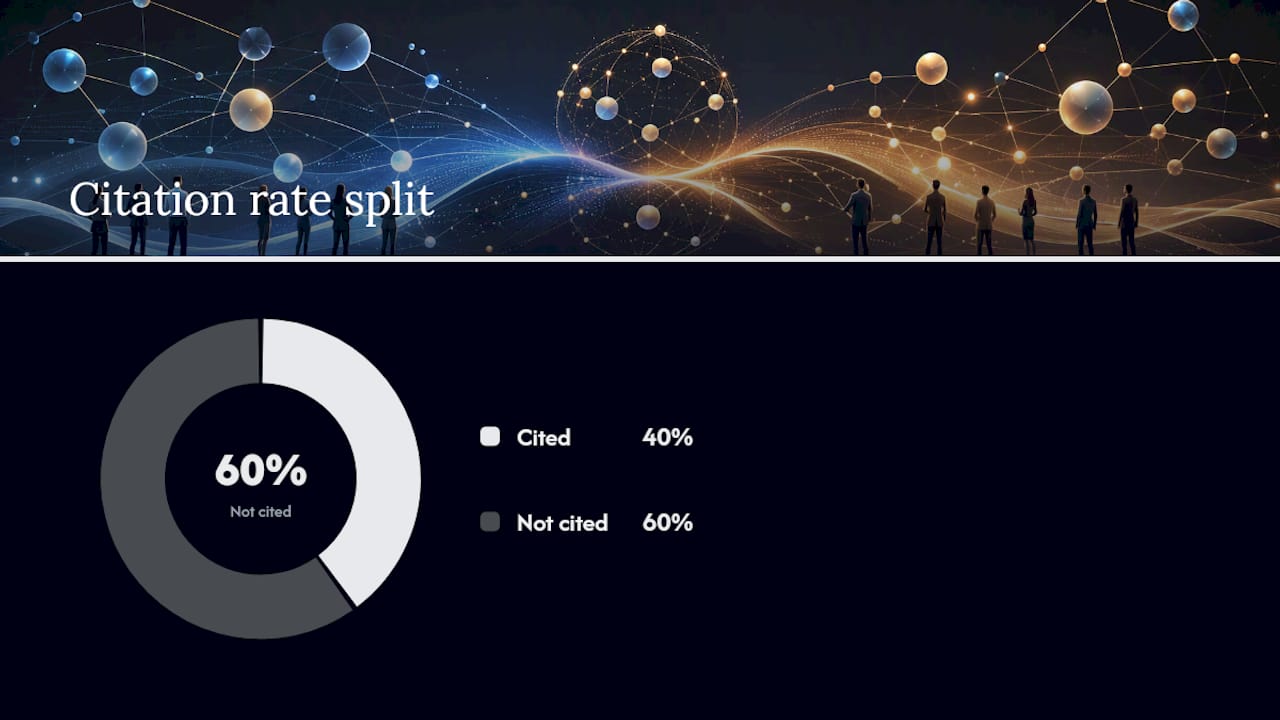
Organic rank alone won’t tell you if any of this is working. The metric that matters here is citation rate, defined as the percentage of tracked prompts where your domain appears as a cited source in the AI-generated response.
- Build a tracked prompt list. Start with 20 to 50 queries that map directly to your priority pages, phrased the way a real searcher would type them, not as exact-match keywords.
- Run those prompts on a fixed schedule. Weekly or biweekly checks catch volatility that a single monthly snapshot would miss entirely.
- Calculate citation rate per page and per topic cluster. A page cited in 8 of 20 tracked prompts has a 40% citation rate, a number you can trend over time the same way you’d trend organic rankings.
- Cross-reference with Search Console impressions and server logs. A sudden crawl frequency drop or an impressions dip on a previously cited page often precedes a citation loss by a few days.
- Run controlled experiments. Take two similar pages, change one variable, an FAQ schema addition, a rewritten opening sentence, a heading format shift, on one and leave the other as a control, then compare citation rate shifts over the following weeks.
HubSpot frames this shift plainly: citation rate across tracked prompts is the more direct success indicator now, not organic position by itself. A page can rank on page one and still never get pulled into a single AI Overview if its passages aren’t structured for extraction.
Courimo’s 30 day tactical checklist for getting cited by AI walks through this exact placement-and-parsability testing cycle if you want a ready-made framework rather than building the experiment structure from scratch.
Concrete E-E-A-T Actions That Actually Move Citations
Author and brand signals aren’t a checkbox exercise. They’re one of the clearest ways to separate a generic content mill from a source a model treats as trustworthy enough to cite by name.
Start with author bylines that link to a real, detailed author page, not a one-line bio buried in a footer. That page should carry Person schema tied to a sameAs link pointing at a verifiable professional profile, LinkedIn, a published bio, a speaker page, something a crawler and a human reader can both confirm independently.
At the organization level, Organization schema with accurate sameAs links to your official social profiles and any third-party listings reinforces that the entity behind the content actually exists and operates where it says it does.
The strongest lever, though, is proprietary data. A generic explanation of a concept competes against a hundred other generic explanations. A specific case study, a named client result, or an original data point that no one else can cite verbatim gives a model a reason to pull your page over a rewritten summary of it. This is exactly the gap Courimo’s own worked extractable-answer examples are built to close, showing a real drafting process rather than a theoretical framework.
- Publish detailed author pages with credentials and verifiable links
- Add Organization schema with
sameAslinks to official profiles - Include original data, named examples, or client results wherever possible
- Keep author and organization information current as roles or credentials change
A Prioritized Action Plan You Can Run This Quarter
Not everything on this list deserves equal urgency. Sequence matters as much as the work itself.
- This week: run the technical audit. Confirm indexing status, check for accidental noindex or robots.txt blocks, and verify rendering isn’t hiding your main content from crawlers.
- This week: add one extractable answer sentence per priority page. Pick your ten highest-traffic pages and rewrite the opening sentence under each key heading to directly answer the question.
- Weeks 2 to 4: roll out FAQPage and Article schema. Start with pages that already have genuine question-and-answer content rather than forcing the format onto pages that don’t fit it.
- Weeks 2 to 6: fix server-side rendering gaps. This is a bigger engineering lift, so scope it early even if execution takes longer.
- Month 2: map the query fan-out for your top ten pages. Identify the two or three subquestions searchers ask alongside your main topic and answer them on the same URL.
- Month 2 to 3: pursue mentions on sites the model already trusts. Outreach for citations, guest contributions, or data partnerships on established industry sites builds the brand-mention signal that’s harder to manufacture internally.
- Ongoing: track citation rate weekly and refresh top pages annually at minimum. Freshness cadence matters more for your highest-value pages than for your entire archive.
Challenges and Limitations in AI Optimization
The biggest limitation isn’t technical. It’s that AI Overview behavior isn’t fully observable from the outside. Google doesn’t publish a ranked list of which signals decided a given citation, so every tactic here comes from correlation, testing, and practitioner observation, not a documented algorithm.
Volatility compounds that problem. A prompt that cites your page today may cite a different source next week with no visible change on your end, since the underlying model, the retrieval set, or the synthesis logic can shift independently of anything you control.
There’s also a scale mismatch. Optimizing for one tracked prompt tells you almost nothing about the thousands of phrasings a real audience uses. A citation rate built on 20 prompts is a sample, not a census, and treating it as gospel leads teams to over-optimize for a narrow slice of query phrasing that may not represent their actual demand.
Cross-platform fragmentation adds another layer. Google’s AI Overviews, Bing’s Copilot answers, and standalone chat assistants each pull from different retrieval systems and weight signals differently. A page tuned heavily for one platform’s extraction preferences may underperform on another, and there’s no single unified playbook that guarantees results across all of them simultaneously.
Finally, correlation isn’t causation. A page that gets rewritten and then gets cited more often might be succeeding because of the rewrite, or because of an unrelated authority signal that improved around the same time. Controlled testing helps, but it rarely isolates variables as cleanly as a lab experiment would.
Case Studies and Practical Examples of AI Optimization in Action
The clearest pattern across practitioner reporting is that pages built around a single, tightly scoped question outperform sprawling pillar pages on citation rate, even when the pillar page ranks higher organically. A page answering “what is a 5 corner e-invoicing model” in two sentences up top tends to get pulled into a synthesis answer more reliably than a 4,000 word guide covering ten related topics where that same definition is buried in paragraph twelve.
Schema testing shows a similar pattern. Teams that add FAQPage markup to a page that already has genuine, visible question-and-answer content report more consistent extraction than teams that add the same schema to a page where the “questions” are really just marketing subheadings, since the mismatch between markup and visible text undermines the very clarity schema is supposed to add.
Freshness cadence produces the most measurable short-term wins. Pages updated with a genuinely revised dateModified field, not just a timestamp bump with no content change, tend to see citation rate recover within weeks when a topic has drifted stale. That’s a faster feedback loop than most technical SEO work offers, which is part of why it’s become a standard first move in most audit checklists.
The common thread across all of it: specificity beats breadth every time the two compete for a single citation slot.
Types of AI Models Commonly Optimized For
Not every AI system pulling from your content works the same way, and the distinction matters more than most guides admit. Google’s AI Overviews rely heavily on retrieval-augmented generation, a process where the system retrieves relevant documents first, then generates a response grounded in that retrieved text, which is why the crawlability and indexing fundamentals covered earlier carry so much weight here.
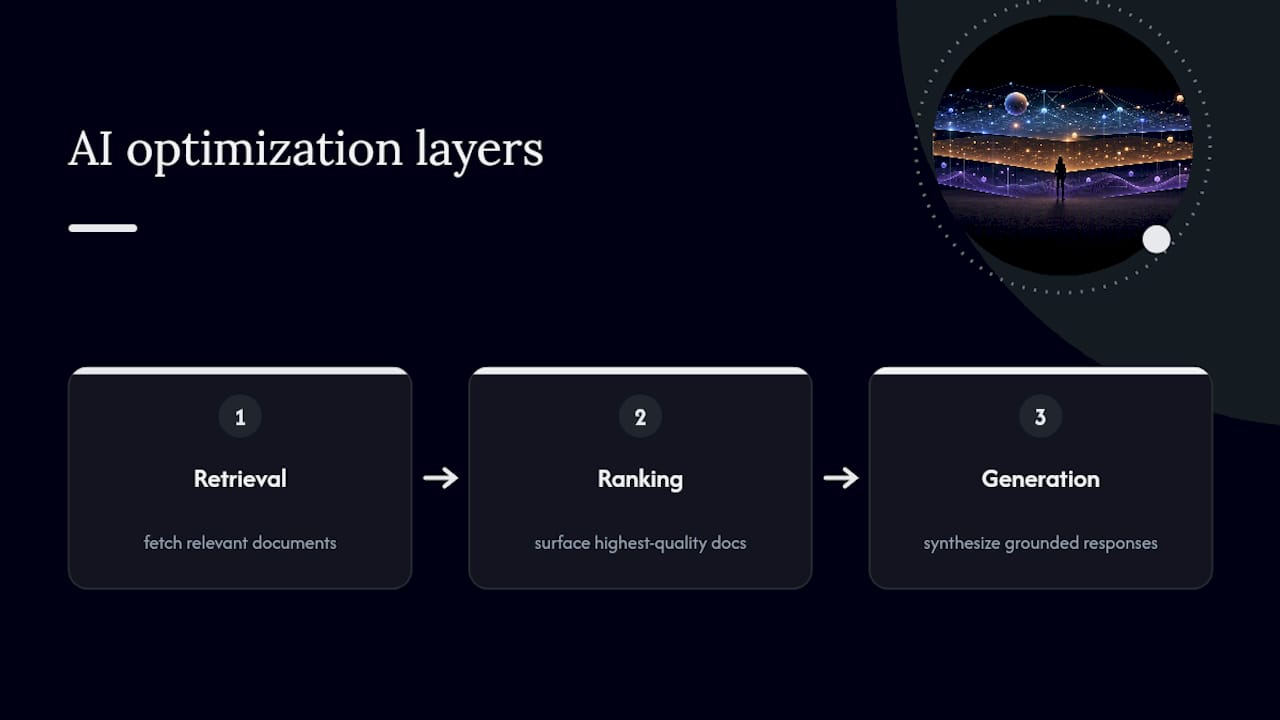
Large language models sitting behind conversational assistants, whether that’s a standalone chat product or a search-integrated assistant, work from a different balance of retrieved content versus what’s already encoded in the model’s training data. That’s part of why brand mentions and prior citations on other sites matter: a model that has “seen” your brand favorably referenced elsewhere brings that association into a live response even without a fresh retrieval hit.
Deep learning based ranking systems, the layer that decides which retrieved documents are worth surfacing at all, are closer to traditional machine learning ranking factors, weighing relevance, technical quality, and historical performance data. This is the layer where Core Web Vitals, indexing health, and structural clarity do their work, before the generative layer ever gets involved in producing the actual text a user reads.
Optimizing for all three layers at once, retrieval, generation, and ranking, is why a single-tactic approach, schema alone, or rewriting alone, rarely produces consistent results on its own.
Performance Metrics That Actually Matter Here
Citation rate is the headline metric, but it’s not the only number worth watching. A handful of supporting metrics tell you why citation rate is moving the direction it’s moving.
Crawl frequency, visible in server logs, tells you whether crawlers are even revisiting a page often enough to catch recent updates. A page updated weekly but crawled monthly won’t reflect its freshness in any AI response for weeks after the edit goes live.
Search Console impressions and average position remain useful as a proxy for whether a page is still considered relevant for its target queries, even though position alone no longer guarantees citation. A sharp impressions drop on a previously well-performing page is often the earliest warning sign of a broader visibility problem, AI citation loss included.
Extraction rate, a more granular version of citation rate that tracks which specific passage or sentence got pulled rather than just whether the domain appeared at all, helps teams diagnose exactly which part of a page is working and which part is dead weight.
And schema validation rate, the percentage of your priority pages with error-free, content-matching structured data, is a quiet but consistent predictor across the pages that consistently retain citations over multiple tracking cycles.
Ethical Considerations and Biases in AI Optimization
Optimizing for extraction carries a real risk of optimizing away nuance. A one or two sentence answer forced to the top of every section can flatten legitimate complexity into something that reads as more certain than it actually is, especially on topics involving health, finance, or legal guidance where caveats matter as much as the headline claim.
There’s also a concentration risk baked into how AI Overviews cite sources. If four to eight sources dominate most citations for a given topic, as Search Engine Land’s data suggests, smaller or newer publishers face a steeper climb to visibility than they did in classic search results, where a well-optimized page could still break through on relevance alone. That dynamic rewards established brand authority in a way that can crowd out genuinely useful newer voices simply because they haven’t accumulated the mention history yet.
Bias in the underlying training and retrieval systems is a separate, harder problem. If a model has been trained predominantly on content from a narrow set of sources or perspectives, its citation behavior will reflect that skew regardless of how well an individual page is optimized. No amount of on-page tactics fixes a systemic retrieval bias, though transparent sourcing and clear attribution on your own content at least ensures you’re not contributing to the noise.
Practitioners have a responsibility here too: optimizing for citation shouldn’t mean stripping out legitimate hedges or nuance just to sound more quotable. Clarity and honesty aren’t actually in conflict, but it takes deliberate editing to keep them that way.
Mistakes to Avoid and Realistic Timelines
The most common mistake is over-optimizing into fragmentation, chopping one good page into five thin ones chasing every possible question variant. That usually backfires, diluting authority instead of building it.
Expect crawl and index fixes to show measurable movement within a few weeks. Brand level signals, mentions, author authority, accumulated trust, take months, not weeks, to shift. Split the work accordingly: content teams own the rewrites and schema, engineering owns rendering and Core Web Vitals, and outreach owns the slower brand mention work running in parallel rather than sequentially.
— Ruthwik
Where Courimo Fits When You Need Implementation Help
Reading a checklist and executing forty items across a live site while running a business are two different jobs. A digital marketing team can run the audit, build the prioritized roadmap, and do the actual content and technical work instead of handing you a slide deck and disappearing.
A typical engagement starts with a technical and content audit against the exact checklist covered above, indexing status, rendering gaps, schema coverage, extractable-answer quality on your top pages. From there, Courimo builds a prioritized roadmap sequenced by effort versus impact, then executes it: search engine optimization work covering content rewrites, schema implementation, and technical fixes; ongoing measurement so you can see citation rate and organic visibility move over time; and, where paid acquisition makes sense alongside organic work, Google Ads management to cover the gap while organic signals build. If your rendering setup is part of the problem, Courimo’s website development team handles that layer directly rather than treating it as someone else’s problem.
If you want a clear-eyed look at where your own site stands before committing to anything, request an SEO quote and get a straight answer on what’s actually blocking your citations, not a generic sales pitch.
Primary References and Tools Cited in This Guide
- Google Search Central: Optimizing your website for generative AI features, the authoritative source for how core SEO fundamentals apply to generative AI features.
- Search Engine Land’s AI Overviews optimization guide, covering extractable passages, query fan-out, and brand authority tactics.
- Search Engine Land: Google AI Overviews explainer, on how and when AI Overviews get triggered.
- HubSpot’s 2026 AI search ranking coverage, including the query-volume figure cited earlier in this guide.
- Semrush’s AI Overviews guide, on crawlability, question-led headings, and schema implementation.
- Google Search Console indexing and coverage help, for verifying index status and diagnosing rendering issues.
Sources
AI Overviews commonly cite between four and eight supporting sources per generated response, according to Search Engine Land’s analysis. That wider citation pool means you’re competing to be one of several winners rather than the single top result, which changes how you should prioritize extractability over raw ranking position.
- Optimizing your website for generative AI features on Google Search
- AI Overviews optimization guide: How to rank in generated results
- HubSpot: AI search ranking coverage (2026)
- AI Overviews: What Are They & How to Optimize for Them
FAQ
How Do I Optimize for Google AI Overviews?
Start by confirming your pages are crawlable and indexed, then rewrite the first sentence of each key section into a direct, self-contained answer. Add Article and FAQPage schema where it genuinely matches your visible content, and track citation rate across a fixed set of tracked prompts, as HubSpot recommends, rather than relying on organic rank alone.
What Is the 80/20 Rule in SEO?
In the context of AI Overviews optimization, that means fixing rendering and rewriting extractable answers on your top ten pages before chasing schema on your entire archive.
Is SEO Still Worth It in 2026?
Yes. Google’s own guidance confirms that core SEO fundamentals remain the foundation for visibility in generative AI features, not a separate discipline. With roughly 48% of queries now triggering an AI-generated response, SEO has shifted toward earning citations inside those responses rather than just chasing blue-link rankings, but the underlying technical and content quality work hasn’t gone away.
How Can I Improve AI Search Optimization Specifically?
Focus on extractable passages: short, direct answer sentences near the top of each section, backed by schema that matches your visible content and author or organization signals that establish credibility. Courimo’s step-by-step approach to building extractable answers is a practical starting point if you want a repeatable drafting process rather than a one-off rewrite.