Ask about eight things before signing anything: process and timeline, how they measure results, who actually does the work, pricing and ownership, proof of past performance, technical capability, content and link tactics, and their honesty about risk. A good agency answers all eight with specifics. Success looks like a named contact, a milestone plan covering early months, and KPIs tied to leads or revenue, not just rankings.
TL;DR:
- Most agencies should provide detailed process timelines and milestones for the first 90 days, including specific deliverables like technical audits and content calendars.
- They must connect metrics directly to revenue or leads, not just rankings, and routinely report on valuable indicators such as impressions and conversions.
- It is essential to verify the team’s experience, avoid subcontracting, and ensure the agency has a clear technical SEO workflow and proven site health strategies.
- Red flags include guarantees of top rankings in short timeframes, vague deliverables, undisclosed link sources, or reluctance to share case studies and sample reports.
- Asking for structured plans, KPI documentation, and real case evidence on reporting and technical capability ensures a more trustworthy and transparent partnership.
Table of Contents
- What to Gather Before You Ask Questions to Hire an SEO Agency
- Core Questions to Ask an SEO Agency, Grouped by Topic
- Questions About Pricing, Contracts, and Who Owns the Work
- How to Evaluate the Proof an Agency Shows You
- Red Flags That Signal a Bad SEO Agency
- A Simple Rubric for Scoring Agency Answers
- Why Most Buyers Ask the Wrong Questions First
- Where Courimo Fits Into This Checklist
- Sources
What to Gather Before You Ask Questions to Hire an SEO Agency
Vague answers usually come from vague questions. If you walk into an agency interview without data in hand, you will get a generic pitch instead of a real plan. Fix that by preparing a short packet before the call.
Pull several months of history from Google Search Console and your analytics platform. This timeframe helps show seasonal patterns while still being recent enough for an agency to review before your call, a window multiple industry guides recommend for exactly this reason, according to DesignRush’s agency interview guide. You want a bare-minimum kit that includes:
- Your top 10 to 20 revenue-driving or lead-generating pages, ranked by traffic or conversions
- Current organic traffic, keyword rankings, and conversion rate for those pages
- A one-paragraph description of your ideal customer and how they typically find you
- A realistic budget range and a timeline for when you need to see movement
With this in hand, an agency can give you a plan tied to your actual site instead of a rehearsed script. Pick the ones tied to your biggest risks and let the rest go.
Core Questions to Ask an SEO Agency, Grouped by Topic
Once you’re in the room, structure the conversation. Random questions get random answers. Working through five groups, in order, forces the agency to show you process, proof, and people rather than just enthusiasm.
Group A: Process and roadmap
Any agency worth hiring can describe what happens in the first 30, 60, and 90 days without checking notes. That milestone framing, rather than a vague “we’ll get started right away,” is a detail DesignRush specifically flags as separating serious operators from sales teams.
- What happens in the first 30 days, and what does a 60 and 90-day milestone look like?
- What’s the longer-term roadmap beyond 90 days, and how does it evolve based on early results?
- How often do you run sprints or planning cycles, and can I see them?
- Who sets priorities each month, and how much input do I get?
- What’s the first deliverable I’ll actually see, and when?
- How do you handle scope changes if my business priorities shift mid-engagement?
An answer worth trusting names specific deliverables (a technical audit by week three, a content calendar by week six) rather than describing “ongoing optimization.”
Group B: Measurement and reporting
Rankings alone tell you almost nothing about revenue. Ask how the agency connects activity to outcomes.
- What KPIs will we track, and how do they map to leads or revenue?
- How do you attribute conversions to organic search versus other channels?
- Can I see a sample report or dashboard before I sign anything?
- How often will we meet to review results, and who runs that meeting?
- What happens if a target isn’t hit by the agreed milestone?
- Do you report on leading indicators, like impressions and clicks on priority pages, or only final rankings?
Strong agencies tie tasks to business metrics and show leading indicators for priority pages rather than isolated ranking snapshots, a pattern HubSpot’s agency checklist points to as a mark of maturity. A tool built for this kind of measurement, like the framework described by Baby Love Growth on measuring SEO performance, shows why this distinction between vanity metrics and business metrics matters so much in practice.
Group C: Team and execution
You’re not hiring a brand. You’re hiring the specific people who’ll touch your account.
- Who exactly will work on my account, and what are their roles?
- How many other accounts does my strategist manage at the same time?
- Is any of the work subcontracted or outsourced overseas?
- What happens if my main point of contact leaves the agency?
- How experienced is the team with my specific industry?
- Will I get direct access to the person doing the work, or only an account manager?
Team questions surface fast whether a proposal is realistic or oversold, since subcontracting patterns reveal who you’ll actually work with day to day, a point Search Engine Journal’s interview question list makes clear when comparing agency staffing models.
Group D: Technical SEO and site health
This is where a lot of agencies get exposed. Technical fluency separates a real SEO operation from a content mill with an SEO label.
- What does your technical audit process cover, step by step?
- How do you evaluate and improve Core Web Vitals?
- How do you handle crawl budget and index bloat on large sites?
- Which CMS platforms have you worked with, and have you worked with mine specifically?
- How do you find and fix duplicate content or canonical issues?
- What’s your process for structured data and schema markup?
SEMrush’s interview question bank covers Core Web Vitals and audit methodology in detail, and it’s worth pushing an agency to go beyond buzzwords here. If they can’t describe a real audit workflow without opening a slide deck, that’s a signal.
Group E: Content and link-building
This group tells you the most about long-term risk, because it’s where shortcuts happen.
- What’s your process for researching and producing content?
- How do you build topical authority across a site rather than chasing individual keywords?
- What link-building tactics do you use, and can you name examples?
- Do you buy links, use link networks, or run any form of paid placement?
- How do you vet a site before pursuing a link on it?
- How do you measure whether content or links actually move rankings?
Pro Tip: Ask the content and link-building questions last. By then you’ve heard how the agency talks about measurement and technical work, so you can tell whether their answer about “natural link building” matches the rigor they showed earlier or contradicts it.
Questions About Pricing, Contracts, and Who Owns the Work
Money questions expose more about an agency’s honesty than almost anything else. Ask them directly, and expect direct answers.
- What’s the pricing model: flat monthly retainer, hourly, or performance-based?
- What’s explicitly included, and what counts as an extra charge?
- Is any payment tied to hitting specific milestones, or is it flat regardless of results?
- Who owns the content, code, and any tools built during the engagement if we part ways?
- What’s the termination clause, and how much notice does either side need to give?
- Do you offer any guarantee, and what exactly does that guarantee cover?
Read the actual statement of work before you sign, not just the sales deck. A vague SOW that says “ongoing SEO services” without listing deliverables is how scope creep starts. Ask for line items: number of pages optimized per month, number of technical fixes, number of content pieces, cadence of link outreach. If ownership of deliverables isn’t addressed in writing, assume you own nothing if you leave, and confirm that before you sign, not after a dispute.
How to Evaluate the Proof an Agency Shows You
Anyone can claim results. Verifiable proof is a different standard, and it’s worth demanding before you commit budget.
- Ask for two or three anonymized case studies showing specific before-and-after metrics, not just “traffic went up.”
- Ask what specific actions produced those results, since a case study without a described mechanism is just a screenshot.
- Request references from clients in a similar industry or business size, and prepare your own questions for those calls (would you rehire them, how did they handle a slow month, how responsive were they).
- Ask to see an actual sample report or dashboard, and have them walk through how a metric on that report changes what they do the following week.
Industry guidance consistently points to sample reports and dashboards as the single fastest way to tell whether an agency ties its work to outcomes or just tracks vanity metrics, a distinction HubSpot’s questions checklist treats as a baseline requirement, not a bonus.
A quick gut check: if an agency can’t produce a single anonymized report within a day of asking, that tells you something about how organized their actual account management is.
Red Flags That Signal a Bad SEO Agency
Some answers should end the conversation immediately. Others just deserve a follow-up question. Learn to tell the difference.
- Any guarantee of a specific ranking position or “top of Google in 30 days” claim
- A refusal to name the specific person who’ll work on your account
- Vague deliverables like “ongoing optimization” with no defined monthly output
- Reluctance to describe their link-building sources or partner sites by name
- Pressure to sign a long contract before you’ve seen a single sample report
- No mention of Core Web Vitals, crawl issues, or any technical audit process at all
Push on link-building specifically. Ask where links come from, whether any involve payment for placement, and how they’d handle a client who wanted to buy links quickly. A confident, specific answer describing outreach, guest content, or digital PR is a good sign. A dodge, or a claim that “our methods are proprietary,” is not.
Pro Tip: If you spot even one red flag, don’t walk away immediately. Ask for the answer in writing, then check it against a reference call. Sometimes a sloppy verbal answer improves once an agency has to put it on paper.
A Simple Rubric for Scoring Agency Answers
Turn what you heard into a number, so you’re not deciding based on who gave the smoothest pitch. Score each candidate agency on four criteria, weighted by what matters most to your business.
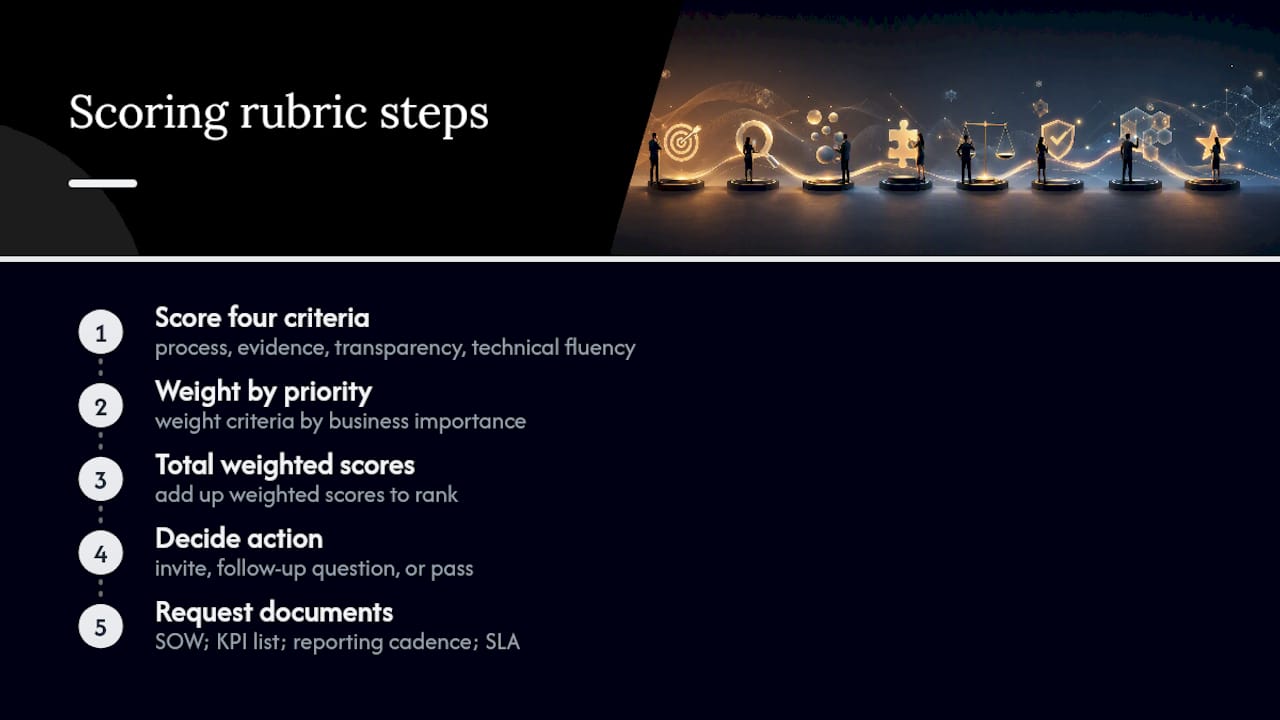
Add up the weighted scores. An agency scoring high across all four earns a proposal request. One scoring well on process and evidence but weak on transparency deserves a direct follow-up question, not disqualification. An agency scoring low on evidence and technical fluency, regardless of how good the pitch sounds, should be a pass.
Before signing anything, request four documents: the signed statement of work, a written KPI list tied to business outcomes, the reporting cadence in writing, and any service-level agreement covering response times. If an agency hesitates to hand over any of these, treat that hesitation as your answer.
Why Most Buyers Ask the Wrong Questions First
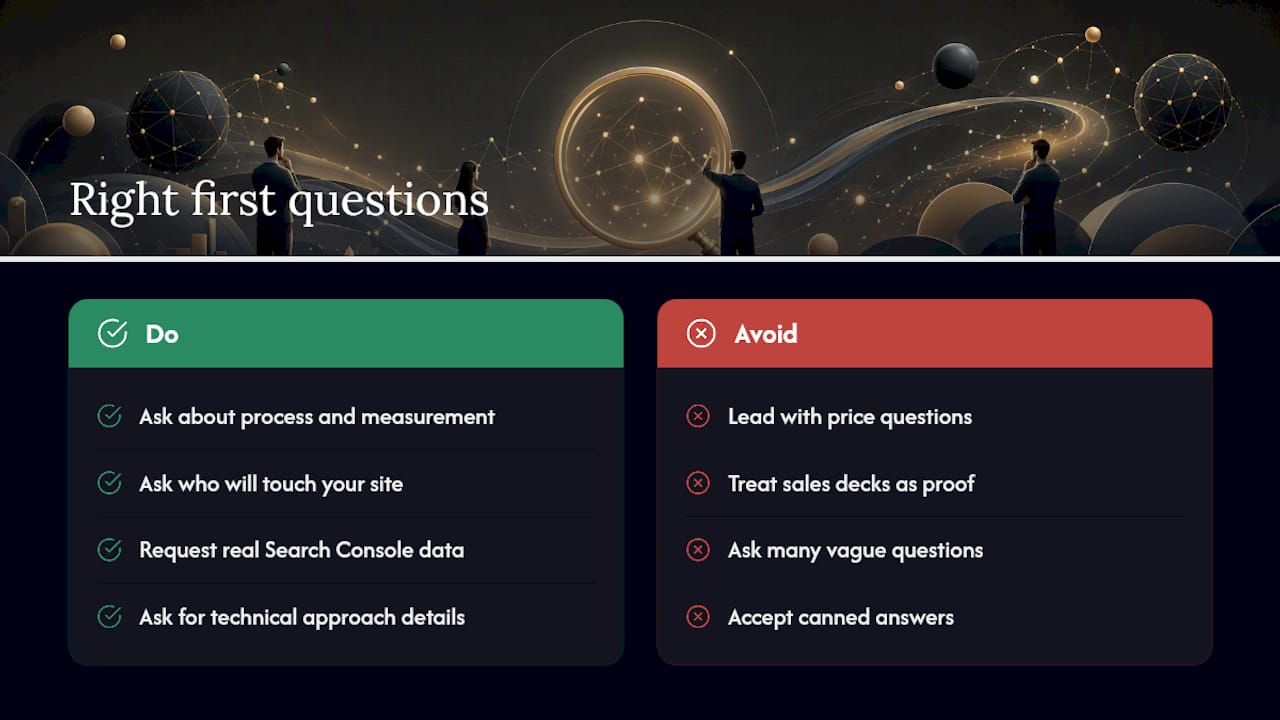
Most business owners start an SEO agency interview by asking about price. That’s backwards, and it’s the single biggest mistake I see in how these conversations get structured. Price only means something once you know what you’re buying, and you can’t judge that until you’ve heard how an agency thinks about process, measurement, and technical work.
The second mistake is treating a polished sales deck as proof of competence. A deck with impressive-looking graphs tells you nothing about who’ll actually touch your site. The team and technical questions in this checklist exist specifically to get past the pitch and into the actual work.
The fastest way to get useful answers isn’t asking more questions. It’s asking fewer questions with real data behind them. An agency that can react to your actual Search Console history in real time is showing you something a canned answer never will.
— Ruthwik
Where Courimo Fits Into This Checklist
If you’ve worked through every question above, you already know what to look for: a named team, a written 90-day plan, KPIs tied to revenue rather than rankings alone, and a sample report you can actually read before signing anything.
A good agency runs on exactly that structure. Every engagement should start with a defined roadmap, a documented scope of work, and a point of contact you can actually reach, not a rotating cast of account managers. Case studies and sample reporting are typically available on request, and pricing should be laid out before any contract gets signed, so there’s no ambiguity about what’s included. If your last agency search left you with more red flags than answers, that’s usually a sign the checklist wasn’t followed on either side of the table.
Request a free SEO quote and bring your Search Console data. You’ll get a real assessment of your priority pages and a milestone plan back, not a generic pitch. If you’re based near Montreal, you can also look at Courimo’s SEO services directly before booking a call.
Sources
- 46 SEO Job Interview Questions to Assess a Candidate’s Knowledge
- 62 SEO Interview Questions + Example Answers
- 12 Questions to Ask an SEO Agency Before You Hire Them
- How to Interview an SEO Agency: 10 Must-Ask Questions