Most PPC management fees run $500 to $10,000 a month, built around five models: percentage of ad spend, flat retainer, hybrid, hourly, or performance-based. Retainers offer budget predictability; percentage models scale with results but can reward spending more, not spending smarter. Whatever model you pick, the management fee sits on top of your actual ad budget, not inside it.
TL;DR:
- Agencies typically charge 10% to 25% of ad spend for monthly management, with rates decreasing as the ad budget increases.
- Flat retainers usually range from $1,500 to $10,000 per month, offering budget predictability, especially for smaller or early-stage accounts.
- Hybrid models combine a fixed base fee with a smaller percentage above a specified spend threshold, balancing growth incentive and budget stability.
- Additional costs often include setup, creative production, landing page optimization, and multi-platform premiums, which can significantly impact total expenses.
- First-time buyers should scrutinize proposals for vague deliverables, lack of account ownership, or guaranteed results, and always verify fee breakdowns and contract clauses.
Table of Contents
- How Do PPC Management Fees Work?
- What Are Typical PPC Management Fees by Ad Spend?
- What’s Included in a PPC Management Fee?
- How Do You Choose the Right PPC Pricing Model?
- What Red Flags Should You Watch for in a PPC Proposal?
- How Do You Estimate Your PPC Management Fee?
- What Makes a PPC Agency Credible on Pricing?
- Agency, Freelancer, or In-House: Which Fits Your Budget?
- Get a Custom PPC Quote from Courimo
- Sources
How Do PPC Management Fees Work?
Every agency prices its work using some blend of five approaches, and the one your prospective vendor pushes hardest tells you a lot about how they think about your account.
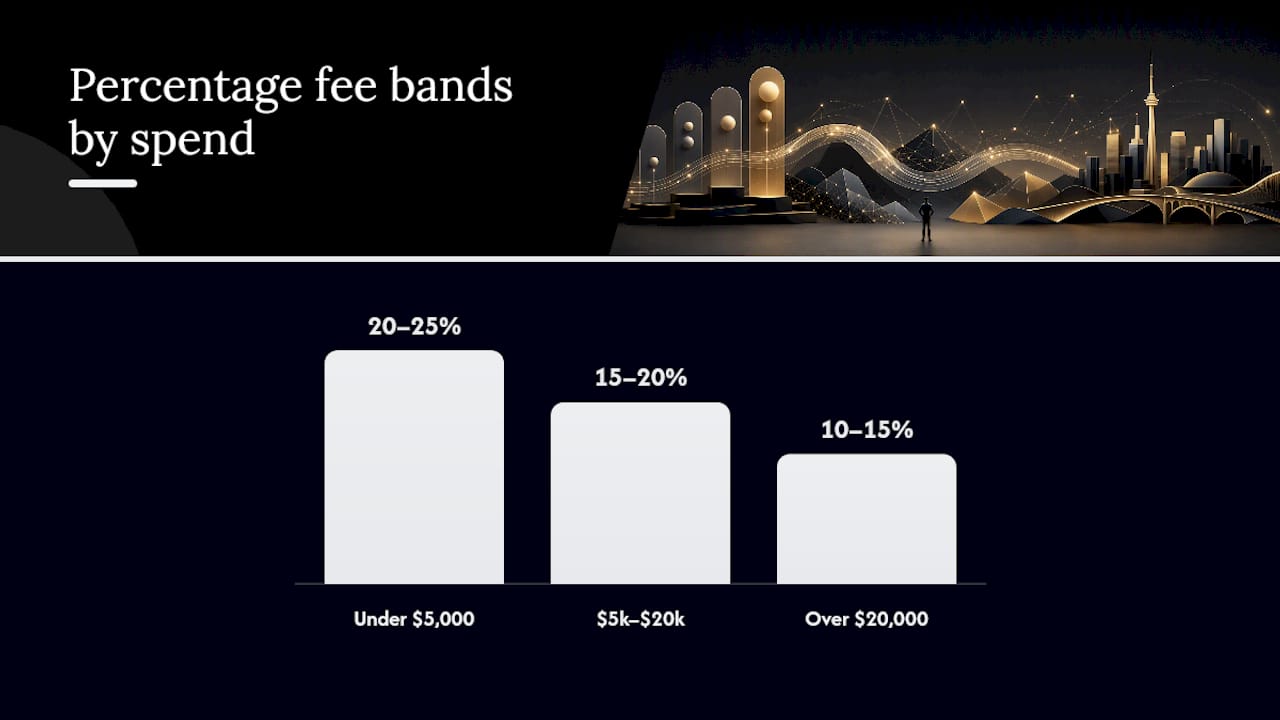
Percentage of ad spend is the industry default. Most agencies charge somewhere between 10% and 25% of monthly spend, and the percentage typically drops as spend climbs: expect 20% to 25% on accounts under $5,000 a month, 15% to 20% in the $5,000 to $20,000 range, and 10% to 15% once you’re above $20,000. The logic is simple. A $50,000-a-month account doesn’t take five times the labor of a $10,000 account, so the rate compresses to keep the fee proportional to actual effort.
Flat retainers charge a fixed monthly number regardless of spend, commonly landing between $1,500 and $10,000 depending on account complexity. This is the model most owners prefer once they’ve been burned once by a percentage deal that ballooned during a seasonal spend increase. A retainer removes any incentive for an agency to push your budget higher just to grow its own invoice.
Hybrid models split the difference: a base retainer covers the core scope, then a smaller percentage kicks in only above an agreed spend threshold. This structure rewards growth without penalizing you for every dollar you spend, and it’s become the preferred format for accounts that expect to scale.
Hourly billing shows up mostly with independent consultants or for defined projects, like a one-time account audit or a campaign restructure, rather than ongoing management.
Performance-based pricing ties some or all of the fee to results, cost per lead or return on ad spend, for example. It sounds appealing on paper, but it’s rare in practice because attribution disputes (“was that conversion really from PPC?”) tend to sour the relationship fast.
Here’s the tradeoff distilled:
- Percentage models align an agency’s upside with a business that wants to grow spend aggressively.
- Flat retainers protect predictable budgets and remove any incentive to inflate spend.
- Hybrids balance both, but only if the threshold is set fairly.
- Hourly fits short, defined projects, not ongoing optimization.
- Performance-based fits businesses with clean, agreed-upon attribution and a high tolerance for negotiation.
Pro Tip: If your monthly spend is likely to double within a year, negotiate a hybrid with a clearly defined threshold now. Renegotiating a pure percentage deal after your budget has already grown gives you almost no leverage.
What Are Typical PPC Management Fees by Ad Spend?
Fee ranges track ad spend closely, and seeing the tiers side by side makes budgeting far less abstract.
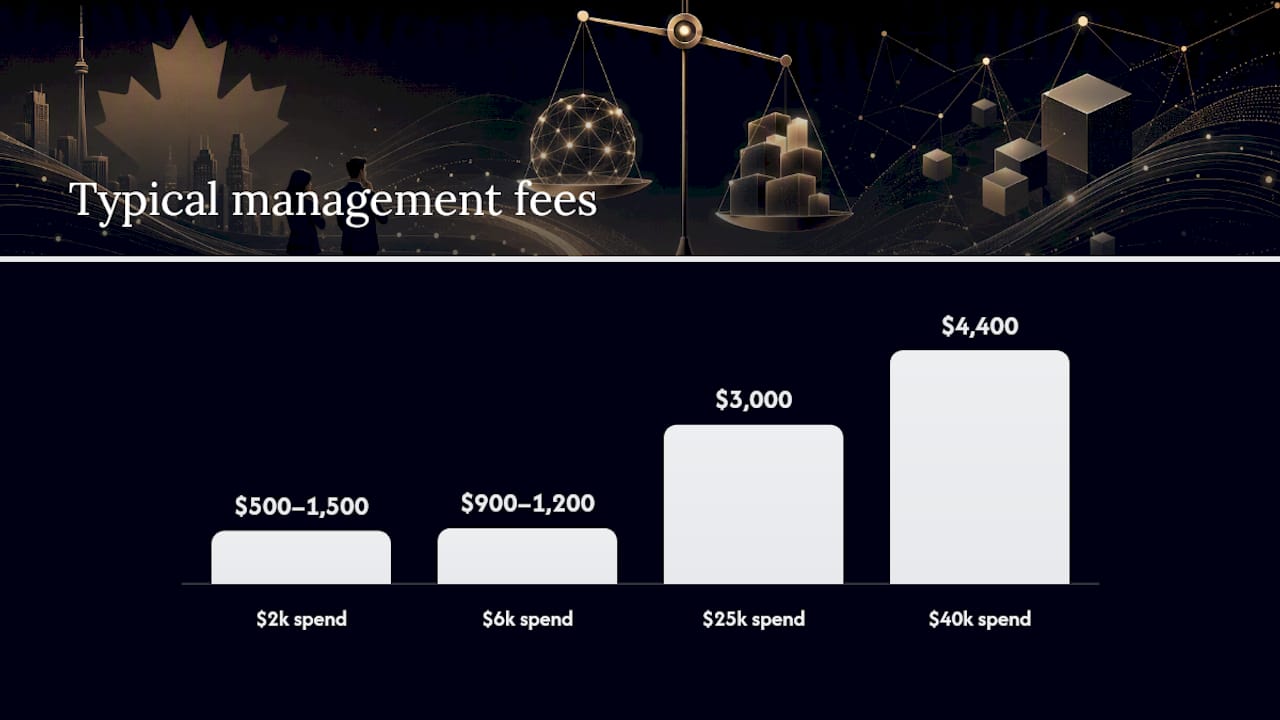
- Under $2,500/month in ad spend. Expect a flat fee or a minimum floor rather than a clean percentage, typically $500 to $1,500/month. At this level, most agencies apply a minimum management fee because a straight 20% cut of $2,000 in spend, just $400, doesn’t cover even a few hours of skilled optimization work.
- $2,500 to $10,000/month. This is where percentage pricing starts to make sense, generally 15% to 20%. On $6,000 in monthly spend, that’s roughly $900 to $1,200 in management fees, on top of the ad budget itself.
- $10,000 to $50,000/month. Percentages compress to roughly 10% to 15%, or agencies shift to flat retainers in the $2,500 to $6,000 range. A $25,000/month account at 12% runs about $3,000 in fees. Boutique agencies commonly serve this tier at $1,500 to $5,000 a month, while mid-market shops charge $4,000 to $12,000.
- $50,000+/month. Percentages drop further, often to 8% to 12%, since the absolute dollar value already justifies a full team. Enterprise-tier agencies frequently price above $10,000/month regardless of the percentage math, because the account demands dedicated strategists, not a shared analyst.
Two quick math checks make this concrete. A business spending $40,000/month at 11% pays $4,400 in fees, on top of the ad budget, for $44,400 total. Notice how the effective rate shrinks as spend rises, even though the dollar fee grows.
Two structural quirks trip up first-time buyers. First, agency minimums mean a tiny ad budget often pays a disproportionately high effective rate, since the floor doesn’t move even if your spend does. Second, multi-platform premiums apply when a campaign runs across Google, Microsoft Ads, and Meta simultaneously. Each platform has its own interface, bidding logic, and reporting quirks, so agencies typically add 10% to 25% to the base fee per additional platform rather than treating it as free scope creep.
Channel choice also matters more than most buyers realize. Search campaigns on Google tend to command higher cost-per-click rates than display, which raises both total spend and the complexity of the account, and that complexity differential is part of why a search-heavy account often costs more to manage than a display-only one at the same dollar spend.
What’s Included in a PPC Management Fee?
A management fee should cover the ongoing work that keeps a campaign healthy, not the one-time builds that get it off the ground. Knowing where that line sits is the single biggest factor in comparing two proposals fairly.
Standard inclusions usually cover:
- Day-to-day bid and budget optimization across active campaigns
- Regular performance reporting, typically weekly or monthly
- Ongoing negative keyword mining to cut wasted spend
- Scheduled strategy calls or account reviews
- A/B testing of ad copy within existing campaign structures
Common add-ons and one-time fees tend to sit outside the base retainer:
- Initial account setup and campaign build, often $500 to $2,500 as a one-time onboarding charge
- Ad creative production, including copywriting, images, or video
- Landing page design and conversion rate optimization (CRO)
- Onboarding a new channel mid-contract, such as adding Microsoft Ads to an existing Google account
- Advanced conversion tracking setup, like server-side tagging
That landing page and CRO line deserves attention because it’s the most commonly missed cost. Skilled management can send perfectly qualified traffic to a page that still won’t convert, and industry guidance consistently flags landing page and CRO work as a separate cost item that materially affects ROI, regardless of how well the ads themselves are managed.
When you’re comparing two proposals, run them through the same checklist: does the fee include strategy calls or bill them separately? Is setup a one-time charge or amortized into month one? Does adding a second platform trigger a new fee, and if so, how much? Answering those three questions upfront prevents a wave of “surprise” invoices in month two.
For a deeper look at what a full-scope campaign build actually involves, Courimo’s PPC marketing guide breaks down the tactical side.
How Do You Choose the Right PPC Pricing Model?
The right model depends less on which one sounds cheapest and more on where your business actually sits.
Five factors should drive the decision: your monthly budget size, your growth stage, how much you value cost predictability versus incentive alignment, your in-house marketing capacity, and how mature your conversion tracking already is. A business with clean attribution and aggressive growth plans can tolerate a percentage model’s variability. A business still figuring out its numbers usually can’t.
Three rules of thumb simplify this further:
- Early-stage or budget-constrained businesses should lean toward flat retainers. Predictability matters more than incentive alignment when every dollar of spend is being justified internally.
- Fast-growing accounts with confident attribution often do well on a hybrid model, since the percentage kicker only activates once spend crosses a threshold you’ve already agreed is worth paying for.
- Large, stable accounts benefit most from negotiated percentage tiers, since the absolute dollar fee stays reasonable even at a lower rate.
Before signing anything, ask the agency these eight questions:
- How many hours per week does our account actually get?
- What deliverables arrive monthly, and in what format?
- Who owns the ad account and conversion data if we leave?
- What’s the cancellation notice period, and are there early-termination penalties?
- Are there performance guarantees, and what happens if they’re missed?
- Do we get direct login access to our own Google Ads and analytics accounts?
- What’s the escalation path if our main point of contact leaves the agency?
- How is a hybrid threshold calculated, and does it reset annually or stay fixed?
That last question matters more than it sounds. Hybrid thresholds negotiated once at account setup can become stale within a year of real growth, so pin down whether the number adjusts automatically or requires a fresh conversation.
What Red Flags Should You Watch for in a PPC Proposal?
Certain proposal patterns should stop you before you sign, and a few quick verification steps confirm whether a fee is actually fair.
Top red flags:
- Bundled ad spend and management fees with no line-item breakdown of each
- Refusal to grant you direct, admin-level access to your own ad accounts
- Vague deliverables like “ongoing optimization” with no defined cadence or reporting format
- Guaranteed results (a specific ROAS or lead volume) with no context about your industry, budget, or history
Verification steps that take five minutes and save months of frustration:
- Ask for a sample report from an existing client (anonymized is fine)
- Request case studies with actual before-and-after metrics, not just logos
- Confirm you’ll retain ownership of the ad account, conversion data, and creative assets if you leave
- Get the SLA in writing: response time, reporting frequency, and escalation contact
Fair onboarding runs 30 to 60 days before full optimization kicks in, and a fair cancellation clause gives you 30 days’ notice with no penalty beyond work already completed. If an agency insists on a 12-month lock-in with no exit clause for a first engagement, that’s a negotiating point worth pushing back on. For more on the metrics worth watching once a campaign is live, see Courimo’s guide to the five key paid search metrics.
How Do You Estimate Your PPC Management Fee?
Three quick formulas cover almost every pricing conversation you’ll have:
- Percentage model: Monthly Ad Spend × Rate (10% to 25%) = Management Fee
- Hybrid model: Base Retainer + (Spend Above Threshold × Smaller Rate, typically 5% to 10%) = Management Fee
- Flat-fee equivalent: Take your expected monthly spend, divide the flat retainer by that number, and compare the resulting percentage against the standard bands to see if you’re overpaying or getting a deal
Two worked examples show how this plays out in practice:
The small account sits near the top of the typical percentage band because low-spend accounts absorb a proportionally higher rate to cover the agency’s minimum labor cost. The mid-sized account lands closer to the middle of its tier, which is where most negotiated deals settle once both sides have seen a few months of performance data.
Inflate either estimate by 10% to 25% if you’re running more than one ad platform, need custom landing pages built from scratch, or require ongoing creative production rather than reusing existing assets. Those additions rarely show up in a headline rate, but they show up on the invoice.
What Makes a PPC Agency Credible on Pricing?
A credible agency scopes a fee the same way every time: an account audit to assess current performance and account structure, a setup phase to build or restructure campaigns, ongoing optimization against agreed goals, and a defined reporting cadence so you’re not chasing your account manager for numbers. A credible agency scopes a fee the same way every time: an account audit to assess current performance and account structure, a setup phase to build or restructure campaigns, ongoing optimization against agreed goals, and a defined reporting cadence so you’re not chasing your account manager for numbers.
Courimo backs its PPC services in Montreal with case study evidence and educational resources for business owners who want to understand the mechanics before signing anything. That transparency is the actual test to apply to any vendor: can they explain their audit process in plain language, and will they show you comparable results from past client work? If a prospective agency can’t answer either question specifically, price becomes a secondary concern. Google’s own Economic Impact reporting has long shown that well-managed campaigns can return multiple dollars in value per ad dollar spent, but only when the account is actually managed well, not just billed monthly.
Agency, Freelancer, or In-House: Which Fits Your Budget?
Freelancers typically run $500 to $2,000 a month and suit businesses with simple, single-platform accounts and tight budgets. You get responsiveness and low overhead, but you’re also exposed if that one person gets sick, gets busy, or moves on. Boutique agencies charge $1,500 to $5,000 a month and bring a small team plus backup coverage, which matters the moment your account gets more complex than one platform. Mid-market agencies run $4,000 to $12,000 and add dedicated strategists and deeper reporting. In-house hiring rarely makes sense below roughly $20,000/month in spend, since a full-time salary plus tools costs more than most retainers at that budget size.
The threshold that flips the math: once your monthly spend consistently exceeds $15,000 to $20,000, compare the fully loaded cost of an in-house hire against a mid-market retainer before assuming ownership is cheaper. Below that, match your pricing model choice to whichever engagement type you land on here.
— Ruthwik
Get a Custom PPC Quote from Courimo
Skip the guesswork of matching your budget to a generic pricing tier. Some agencies offer PPC management built around your actual ad spend, with certification and case study evidence you can review before committing to anything.
Because Courimo scopes every engagement around your specific account rather than a one-size retainer, you get a fee structure that matches your growth stage instead of forcing your budget into someone else’s tier system. That means a Montreal small business spending $6,000 a month gets priced differently than an enterprise account spending $60,000, with the audit and setup phases scoped accordingly rather than templated. Request a free PPC quote from Courimo’s certified Google Ads team and get a fee breakdown specific to your ad budget before you sign anything with anyone.
Sources
- PPC Management Pricing: What Agencies Charge in 2026 (+ Calculator) | Pitchsite
- Quarterly revenue of Google | Statista