A working LinkedIn content strategy builds topical authority, grows the right audience, and produces a measurable sales pipeline, not just likes. It runs on one goal, one ideal customer profile, and three to four content pillars posted on a repeatable schedule. Start today by writing down that single goal, that one audience, and your first pillar topic before you draft a single post.
TL;DR:
- A consistent content system focusing on a single goal, customer profile, and 3-4 pillars outperforms chaotic posting and random topics over time.
- Using high-engagement formats like carousels, documents, and short videos drives longer dwell time and higher median reach than simple text posts.
- A posting cadence of three times weekly, with a balanced content mix and timing tested through experimentation, yields better results than daily posting.
- Tracking early engagement metrics such as comment velocity and share rate helps predict a post’s distribution and overall strategy success.
- Batching content creation and aligning formats with specific pillars streamline publishing, while a clear measurement cycle refines what’s working for pipeline growth.
Table of Contents
- Why a LinkedIn Content Strategy Matters More in 2026
- How to Build Your LinkedIn Content Strategy Step by Step
- Choosing Content Pillars and the Right Formats for Each
- Writing Posts That Stop the Scroll and Get Shared
- Posting Cadence, Weekly Calendar, and Timing Tactics
- Measuring What Actually Matters on LinkedIn
- Batching and Tools for Consistent Publishing
- Templates You Can Use This Week
- Why Trust This Playbook
- Our Take on Running LinkedIn Strategy
- Get Courimo’s Help Running Your LinkedIn Strategy
- Where This Playbook Comes From
- Sources
Why a LinkedIn Content Strategy Matters More in 2026
LinkedIn’s ranking signals have shifted toward matching content to interest graphs rather than just chronology or raw follower count. The platform now favors meaningful conversation, original expertise, and dwell time, which rewards posts that keep readers on the screen and pull them into the comments. Formats like carousels, documents, and short video tend to outperform in this environment because they hold attention longer than a quick scroll past a paragraph.
Most creators and brand pages don’t lose because they post too little. They lose because they post without a system, and the failure modes repeat across nearly every stalled LinkedIn page:
- Random topic selection with no pillar discipline, so followers can’t predict what they’ll get from you.
- Inconsistent posting that resets algorithmic trust every time a gap hits two or three weeks.
- Content built to showcase the author instead of transforming the reader, which kills shareability.
- No tracking beyond vanity metrics, so nobody notices which posts actually move the business.
A documented system fixes this because it removes daily decision fatigue. You’re not asking “what do I post today?” You’re pulling from a pillar list and a calendar you built once. The early comment window, the first 60 to 120 minutes after publishing, has become one of the strongest distribution signals, according to Postiv’s 2026 framework breakdown, meaning a planned strategy that includes an engagement window beats spontaneous posting almost every time.
How to Build Your LinkedIn Content Strategy Step by Step
Building this out isn’t complicated, but skipping steps is exactly why most strategies stall after week three. Work through these in order.
- Set one measurable goal and its primary KPI. Pick a single outcome, inbound leads, newsletter signups, or sales calls booked, and attach one number to it. A goal like “grow brand awareness” can’t be measured; “generate 15 qualified conversations per month from LinkedIn” can.
- Define a specific ideal customer profile. Skip job titles alone. Describe the problem this person is actively trying to solve, the tools they already use, and where they get stuck. “VP of Sales at a 50 to 200 person B2B software company who can’t get reps to log activity in the CRM” gives you infinitely more to write about than “sales leaders.”
- Choose three to four content pillars. Each pillar should map directly to a problem your ICP faces and a strength you can speak to with real experience. More than four pillars and your page starts feeling scattered; fewer than three and you run out of angles by month two.
- Select two or three formats you can sustain. Don’t chase every format LinkedIn supports. Pick what you can produce consistently at a quality bar you’re proud of, then map each format to the pillar it serves best.
- Pick a cadence and a content-mix ratio that match your capacity. Three posts a week is a realistic starting cadence for most solo professionals and small teams. Layer in a mix ratio, the funnel-based approach recommends a baseline of 4 awareness posts to 2 trust posts to 1 lead-generation post across a given stretch of content, so you’re not accidentally pitching in every single post.
- Build a measurement and review rhythm. Weekly glance, monthly deep dive. Without this step, steps one through five just become guesses you never correct.
Pro Tip: Write your ICP description as if you’re describing a specific person you’ve actually had a conversation with, not a demographic category. If you can’t picture their face, your content pillars will stay generic.
The goal-first sequencing matters because everything downstream depends on it. Content pillars chosen before you know your KPI tend to drift toward whatever’s interesting to write, not what actually builds your pipeline. That’s the single most common reason a LinkedIn marketing plan looks great on paper and produces nothing in the CRM three months later.
Notice also that step three and step four are separate decisions. Pillars are about what you talk about. Formats are about how you deliver it. Conflating the two is how people end up trying to do carousels, video, newsletters, and text posts, all for four different pillars, and burning out inside a month.
One more thing worth stating plainly: this system doesn’t require daily posting to work. A tighter cadence executed consistently against clear pillars will outperform a chaotic daily habit almost every time, because consistency and topical focus matter more than sheer volume on this platform.
Choosing Content Pillars and the Right Formats for Each
Start with a brain dump: write down ten topics your ICP cares about, drawn from sales calls, support tickets, or comments you’ve seen on other posts in your niche. Then overlay that list against your own genuine expertise and the goal you set in step one. Where those two circles intersect, you’ll usually find your three or four pillars sitting right there, obvious once you see them.
Once pillars are locked, match them to formats based on what each format actually does well:
- Documents and carousels work best for frameworks, step-by-step breakdowns, and anything with a clear beginning, middle, and end readers can swipe through. These formats tend to deliver especially high median reach relative to how often they’re used, largely because swiping keeps a reader active on the post longer than a static scroll.
- Text posts are the fastest to produce and work well for opinions, quick lessons, and story-driven trust content, provided the writing itself carries the weight.
- Vertical video suits demonstrations, behind-the-scenes moments, and anything that benefits from tone of voice, but it only pays off when the production quality clears a real bar.
- Polls are lightweight engagement tools best used sparingly to surface audience pain points you can turn into future pillar content.
- Newsletters work for recurring roundups or deeper analysis that a single post can’t hold, and they build a direct subscriber relationship separate from the feed algorithm.
A simple rule: if the pillar is educational and step-based, default to a document or carousel. If it’s a personal lesson or opinion, default to text. If it needs to be seen and heard, use video, sparingly, and only when the topic actually demands it.
Writing Posts That Stop the Scroll and Get Shared
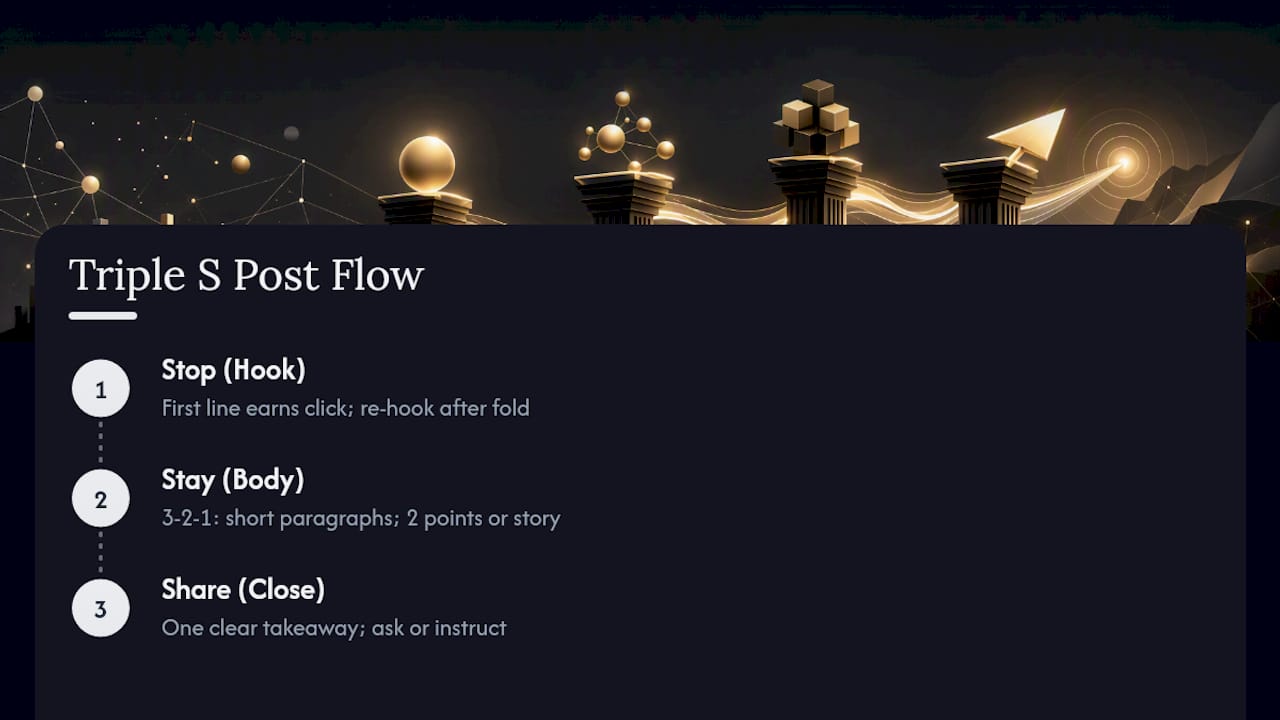
Every high-performing post follows some version of what’s often called the Triple S: Stop, Stay, Share. The hook has to stop the scroll in the first line. The body has to keep someone reading long enough that LinkedIn registers dwell time. The close has to give them a reason to share or save it.
A useful microstructure inside that framework is the 3-2-1 pattern: three lines to hook and set context, two supporting points or a short story, one clear takeaway that closes the loop. Because LinkedIn truncates posts and shows a “see more” link, your hook is really doing two jobs. It has to earn the click to expand, and then it needs a quick re-hook right after the fold to confirm the click was worth it.
Readability on mobile matters more than most people give it credit for. Short paragraphs, generous line breaks, and no walls of text. If you need to link out, drop it in the first comment rather than the post body. External links inside the post itself tend to suppress reach, and the same discipline around structured, scannable writing shows up in how consultants price and present their own service pages, where clarity does the selling instead of density.
Endings deserve as much attention as hooks. Content built to hand the reader a clear takeaway or a step they can apply immediately gets shared far more than content built purely to showcase the author, and shares carry outsized weight as an engagement signal compared to a like or a passive view.
Pro Tip: Read your closing line out loud. If it sounds like a conclusion instead of a handoff, rewrite it as a question or a direct instruction the reader can act on in the next five minutes.
Posting Cadence, Weekly Calendar, and Timing Tactics
Three posts a week is the right starting cadence for almost everyone building this from scratch, tied to three pillars so each post has an obvious home. Once that rhythm feels manageable, scale toward four or five posts a week by adding a second format to an existing pillar rather than inventing a fourth pillar.
- Run your starting cadence for eight to twelve weeks without changing pillars.
- At the end of that window, pull your top five posts and look for the pattern, refining pillars and formats based on what actually performed rather than what you assumed would work.
- Adjust one variable at a time, format, timing, or hook style, so you know what caused the change.
A sample weekly calendar for a three-post cadence:
| Day | Pillar Focus | Format |
|---|---|---|
| Monday | Industry insight / awareness | Text post |
| Wednesday | Framework or how-to | Document / carousel |
| Friday | Personal lesson / trust building | Text post with story |
Timing is worth testing rather than guessing. Run a four-week experiment where you post at a consistent time each day, then rotate the time slot every week, morning, mid-morning, early afternoon, and compare impressions and comment velocity across the same pillar. The window that produces the fastest early comments is usually your best publishing slot going forward, since that early activity window strongly shapes how far LinkedIn distributes the post.
Measuring What Actually Matters on LinkedIn
Two categories of metrics deserve your attention, and confusing them is why so many people optimize for the wrong thing. Leading indicators tell you if a specific post is resonating right now. Lagging indicators tell you if the whole strategy is moving your business goal.
Leading indicators worth watching weekly:
- Impressions, as a baseline reach signal.
- Comment velocity in the first hour, since early conversation strongly predicts total distribution.
- Share rate per impression, one of the clearest signals of content that’s actually useful to the reader.
- Saves, which flag reference-worthy content even when public engagement looks modest.
Lagging indicators worth watching monthly:
- Direct messages started from a post or profile view.
- Website or landing page clicks attributed to LinkedIn.
- Pipeline value, deals or conversations that trace back to LinkedIn as the origin.
Prioritizing everything at once is how measurement collapses into noise. Pick one leading metric and one lagging metric tied to the goal you set in step one, and review those two before anything else. Comment rate and shares per impression are the two leading metrics worth treating as your primary early-warning indicators, since both correlate closely with whether the algorithm keeps distributing a given post beyond your immediate network.
Batching and Tools for Consistent Publishing
A short weekly batching session beats daily scrambling for almost every solo professional and small marketing team. A simple version, often called a Sunday session, runs through five steps: ideation, drafting, visual asset creation, scheduling, and planning your engagement window for each post.
Tool categories that reduce friction, without locking you into a single named vendor:
- Drafting tools for capturing hooks and outlines the moment an idea hits, rather than losing it by Monday.
- Design template tools for producing carousels and documents without rebuilding a layout from scratch each time.
- Scheduling tools that let you queue a week or two of posts in one sitting.
- Analytics tools that surface comment velocity and share rate, not just impressions.
For teams beyond a single person, governance keeps quality consistent: a lightweight approval step, a short voice guide covering tone and banned phrases, and a plan for turning employees into amplifiers rather than relying on one company page to carry all the reach. Employee advocacy works best when it’s optional and easy, a shared draft comment or a suggested repost window, not a mandate that feels like homework.
Templates You Can Use This Week
Copy this structure directly and adjust the topics to your own pillars.
One-week calendar:
- Monday, Pillar A (industry insight), text post.
- Wednesday, Pillar B (how-to framework), document or carousel.
- Friday, Pillar C (personal lesson), text post with a short story.
Three post blueprints:
- The Mistake Post: Hook names a common mistake your ICP makes. Body explains why it happens and what it costs them. Close with the one-step fix.
- The Framework Post: Hook promises a specific process in a specific number of steps. Body walks through each step briefly, ideally as a carousel. Close by inviting readers to save it for later.
- The Story Post: Hook drops the reader into a moment of tension or a small setback. Body walks the actual sequence of events. Close on the lesson and a question that invites comments.
Before publishing anything, run through a quick checklist:
- Preview the post on mobile, since that’s how most of your audience will see it.
- Make sure your image or carousel cover matches the promise in your first line, not a generic stock graphic.
- Drop any external link in the first comment instead of the post body.
Why Trust This Playbook
This framework comes from combining current platform signals with a funnel-based content structure that’s been tested across creators and brand pages, not a single lucky post that went viral once. Courimo applies this same structure when running LinkedIn strategy engagements for B2B clients, pairing content pillars with paid amplification once organic performance validates a topic.
A few practical markers worth checking before you trust any advice on this topic, including this article:
- Does the source distinguish leading metrics from lagging ones, or just report vanity numbers?
- Does it show a repeatable process rather than a single anecdote?
- If a result is cited, is it specific enough to verify, or vague enough to mean nothing?
When evaluating a marketing partner’s claims, ask for anonymized before-and-after data covering at least one full quarter. Anyone hesitant to show even a sanitized version of that data is asking you to trust their word alone.
Our Take on Running LinkedIn Strategy
LinkedIn should be treated as a measurable channel, not a brand exercise. That means every content pillar should be tied to a pilot test, usually four to eight weeks, with clear KPIs before calling it a win. One recurring pattern is that pairing a strong organic post with a small paid boost behind it consistently outperforms either tactic alone. If you’re stuck, run a single pillar for one month before touching the rest of the plan.
— Ruthwik
Get Courimo’s Help Running Your LinkedIn Strategy
LinkedIn content strategies benefit from having one goal, a defined audience, and pillars tied to formats that move the needle, backed by measurement instead of guesswork.
A typical starter engagement runs through three phases: an audit of your current profile and past content performance, a pilot content sprint built around two or three pillars, and a measurement plan that ties activity to real pipeline instead of vanity metrics. Courimo’s team handles the content creation and posting cadence while layering in paid amplification where organic testing shows a pillar is working. If your company page and profile need work before content can carry any weight, that gets addressed in the audit phase too, since a thin profile undercuts even the best post.
Ready to see what a structured pilot could look like for your business? Reach out through Courimo’s LinkedIn strategy page to scope a starter engagement and get a plan built around your actual goal, not a generic template.
Where This Playbook Comes From
The frameworks in this article draw on several current guides worth bookmarking for deeper reading. Hootsuite’s LinkedIn marketing strategy guide covers the platform’s current ranking signals in detail. Social Media Examiner’s prospect-focused content guide breaks down the funnel-based posting ratio referenced throughout this piece, and its companion piece on writing without AI covers share-worthy post construction. Buffer’s LinkedIn marketing breakdown is a solid reference for format-by-format reach data, and Supergrow’s 10-step system lays out the cadence testing approach used in the step-by-step section above.
Sources
- Mastering LinkedIn content marketing: Strategies and examples
- How to Create Content on LinkedIn to Attract Your Ideal Prospects
- LinkedIn marketing: strategies and examples