Most Canadian small businesses should budget somewhere between $2,500 and $15,000 for a professionally built website in 2026, with a straightforward brochure site landing near the middle of that range. DIY builders drop the upfront number to a low annual range, while custom-coded builds with e-commerce or booking systems can cost significantly more. Add a monthly amount for hosting, maintenance, and software licenses once the site is live, regardless of which tier you choose.
TL;DR:
- Smaller projects like landing pages or brochure sites typically cost between $3,000 and $15,000, depending on scope and features.
- Larger e-commerce or custom applications can range from $10,000 up to $50,000 or more, with timelines stretching from six months to over a year.
- Regional differences mean Toronto and Vancouver agencies charge 10% to 20% higher, especially for bilingual or complex projects.
- Ongoing expenses for hosting, maintenance, and licenses usually total $100 to $250 per month, often underestimated by first-time owners.
- Clear scope definition and detailed quotes are essential to avoid large discrepancies and ensure the final cost aligns with your business needs.
Table of Contents
- Website Design Cost in Canada: A Quick Snapshot By Tier
- Website Design Cost in Canada By Project Type
- What A Website Actually Costs, Line By Line
- The Variables That Actually Move Your Quote
- Ongoing Costs: What Your Website Costs After Launch
- Getting Quotes That Actually Compare
- When Hiring An Agency Actually Pays Off
- Get A Website Development Quote Built For Canadian Budgets
- Sources
Website Design Cost in Canada: A Quick Snapshot By Tier
Before you request a single quote, it helps to know which tier fits your business. Every Canadian web project falls into roughly five buckets, and the gap between the cheapest and most expensive is enormous, mostly because “website” means wildly different things to different owners.
DIY / site-builder. Platforms like Wix, Squarespace, or the GoDaddy builder run about $170 to $336 a year for hosting and a template license, according to GoDaddy’s Canadian pricing breakdown. You do the layout work yourself. This suits a solo consultant or a new business that needs a digital business card, not a lead-generation engine.
Template plus customization. A freelancer or small studio takes a WordPress theme, customizes the colors, structure, and copy, and hands you something that looks bespoke without the full custom-code price tag. Expect $1,500 to $5,000 upfront.
Freelancer or boutique build. A solo developer or two-person shop builds something closer to custom, often still on WordPress for cost efficiency, generally costing several thousand dollars.
Mid-market agency. This is where most established Canadian small businesses land: $5,000 to $25,000 for a professionally designed, SEO-structured site with proper content strategy and testing.
Custom web application. Booking platforms, member portals, or anything with real backend logic starts at a substantial amount and can vary widely for complex projects for complex, feature-heavy builds, per Quantro Digital’s 2026 pricing benchmarks.
Here’s how those tiers map to what you actually get:
- DIY/site-builder: a low upfront annual cost, best for solo operators testing an idea
- Template + customization: $1,500 to $5,000 upfront, best for service businesses needing a credible presence fast
- Freelancer/boutique: several thousand dollars upfront, best for tight budgets that still want some design originality
- Mid-market agency: $5,000 to $25,000 upfront, best for businesses that depend on the site for leads or sales
- Custom web application: from tens of thousands to much higher depending on complexity, best for businesses with logins, bookings, or proprietary workflows
The mistake most owners make is picking a tier based on price alone, then discovering halfway through that their functional needs (online booking, a bilingual catalog, inventory sync) belong two tiers up.
Website Design Cost in Canada By Project Type
Project type matters more than almost any other variable in your quote. A five-page brochure site and a fifty-product e-commerce store are not the same job wearing different clothes, they’re different disciplines with different timelines.
Landing pages and mini-sites. A single-page site built to support one campaign or product launch runs $3,000 to $5,000 and typically ships in one to two weeks, according to Quantro Digital. This is the fastest, cheapest professional option on the list.
Brochure sites (5 to 15 pages). The bread-and-butter project for most Canadian small businesses. GoDaddy pegs the low end around $170 for a bare-bones DIY version, but a professionally designed brochure site with copywriting, photography, and basic SEO often cost several thousand dollars, per GoDaddy’s Canadian cost guide. Timeline: four to eight weeks.
Small to medium e-commerce. Expect $5,000 to $10,000 for a straightforward online store with under 100 products, standard payment processing, and a template-based theme. Timeline runs six to ten weeks, longer if you’re building out product photography and descriptions from scratch.
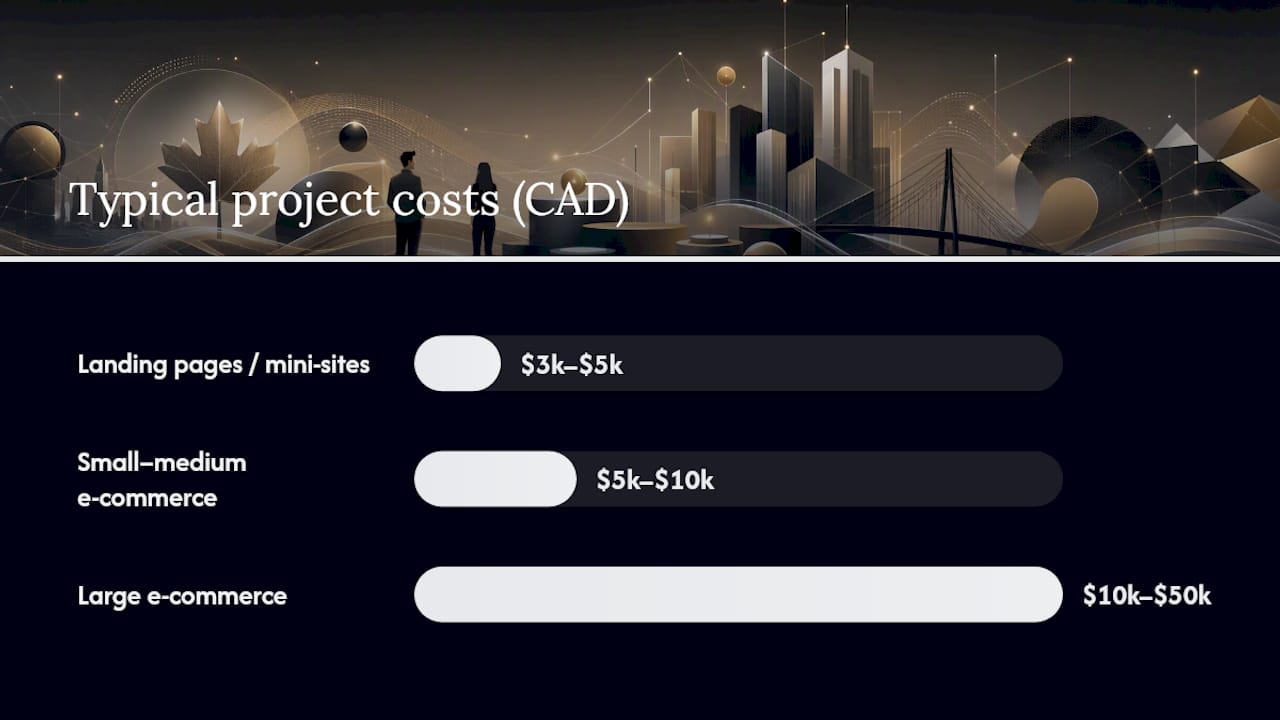
Large e-commerce. Once you need custom checkout flows, inventory syncing across multiple sales channels, or thousands of SKUs, costs climb to $10,000 to $50,000 or more. Build time stretches to three to six months.
Custom web applications. Anything with logins, custom dashboards, or proprietary business logic (think a scheduling platform or a client portal) starts at a substantial amount and may be much higher for complex custom web applications for enterprise-grade builds, with timelines of four to twelve months.
The $5K vs. $15K Reality Check
At $5,000, you typically get a template-based design, five to eight pages, basic contact forms, and minimal copywriting support. At $15,000, you get custom page layouts, professional copywriting, on-page SEO structure, a content management system your team can actually use, and testing across devices before launch. The gap isn’t cosmetic. It’s the difference between a site that exists and a site built to convert traffic into leads.
Regional pricing adds another wrinkle. Toronto and Vancouver agencies tend to charge 10% to 20% more than the national average because of higher local labor costs, a pattern Metro Vancouver IT’s regional pricing data confirms across multiple project types.
A short list of what shifts a quote within any single project type:
- Number of unique page templates versus repeated layouts
- Whether content and photography are supplied or need to be created
- Integration complexity (payment gateways, booking tools, CRM sync)
- Bilingual requirements for Quebec-based or nationally serving businesses
- Revision rounds built into the contract
What A Website Actually Costs, Line By Line
Ask any agency for an itemized quote and you’ll see the total break into a handful of recurring categories. Knowing these lets you spot a padded quote or a suspiciously cheap one.
- Domain registration: $10 to $20/year, recurring, through any Canadian registrar
- Hosting: $10 to $50/month for shared or managed hosting, scaling to $100+ for high-traffic e-commerce, recurring
- Design and build (one-time): the bulk of your quote, ranging from $170 DIY to $500,000+ for enterprise custom apps, as outlined by GoDaddy’s Canadian pricing guide
- SSL certificate and security: often bundled free with hosting now, but dedicated security monitoring runs $10 to $50/month, recurring
- SEO setup: $500 to $3,000 one-time for technical SEO and on-page structure, with ongoing SEO work billed separately
- Content creation (copywriting, photography): $500 to $5,000 one-time, depending on page count and whether photography is included
- Third-party integrations: payment processors, booking widgets, and CRM connections often run $500 to $3,000 each to configure properly, one-time plus possible monthly platform fees
- Plugins and premium themes: $50 to $500/year for premium WordPress plugins covering forms, SEO tools, or e-commerce functionality
Bilingual builds add real cost here specifically at the content layer. Accessibility work (proper heading structure, alt text, keyboard navigation) rarely shows up as its own line item but should be baked into the design and build phase. If it’s missing from a quote entirely, ask why.
Privacy and security requirements have also gotten more specific. If your site collects customer data, you need a documented privacy policy and, depending on your sector, may need to budget for PIPEDA-compliant data handling practices, which can add legal review costs outside the web build itself.
The Variables That Actually Move Your Quote
Two businesses can request “the same” website and get quotes $20,000 apart. The difference almost always comes down to a handful of factors vendors weigh when pricing a project.
Unique page designs versus repeated templates. A site with fifteen pages built from three reusable templates costs far less than fifteen pages each with a custom layout. Ask every vendor how many unique templates their quote assumes.
Integration count and complexity. Payment gateways, booking systems, CRM connections, and email marketing sync each add development and testing time. A site with three integrations is a meaningfully different project than one with zero.
Content scope and who provides it. Quotes assuming you supply finished copy and photography run cheaper than ones that include content creation. Confirm which side of that line your quote falls on before comparing numbers.
Team composition and hourly rates. A solo freelancer might bill $50 to $100/hour. A mid-market agency team involving a designer, developer, and project manager often bills a blended rate of $100 to $200/hour. More people touching the project means more coordination overhead, which shows up in the total.
Geography and bilingual scope. Toronto and Vancouver rates run higher than smaller markets, and Montreal projects requiring full bilingual builds add real scope, not just translation, per Metro Vancouver IT’s regional analysis.
Pro Tip: Ask every vendor to break their quote into design, development, content, and integration hours separately. A vendor who can’t or won’t itemize is usually padding one category to make another look competitive.
Ongoing Costs: What Your Website Costs After Launch
Launch day is not the finish line, it’s the start of a recurring bill most first-time website owners underestimate. Plan for these before you sign a contract, not after your first renewal invoice.
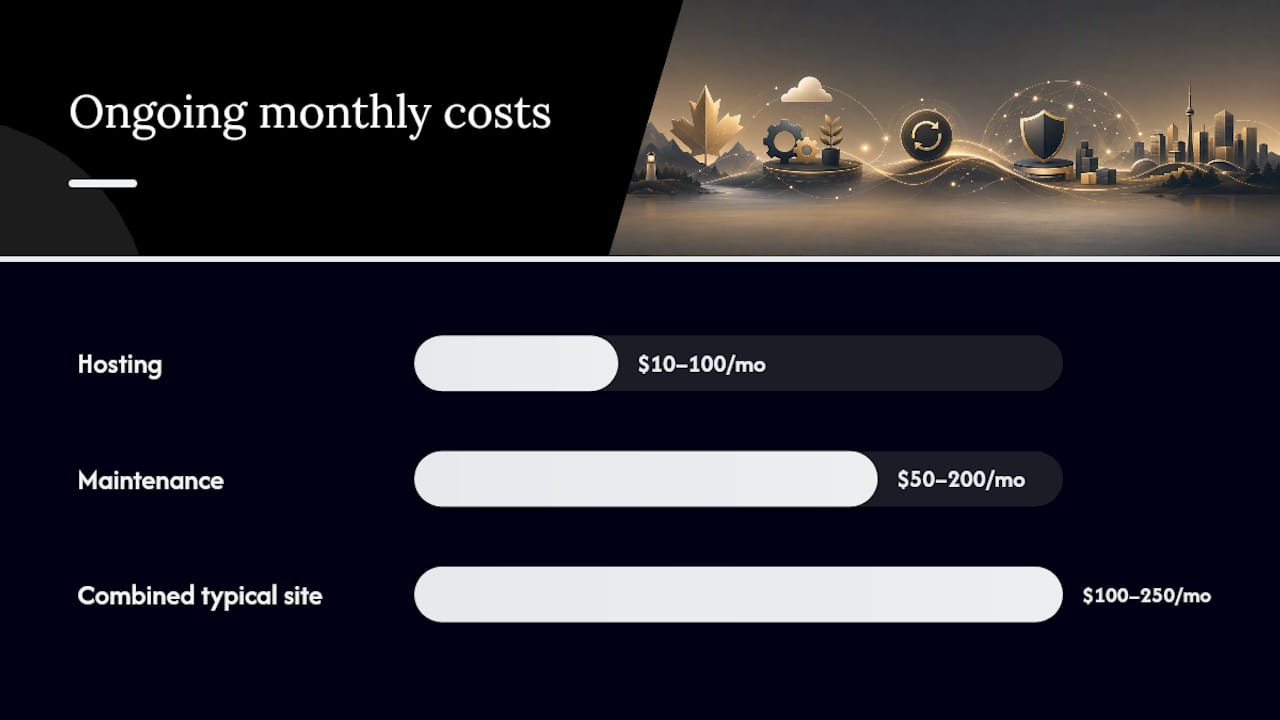
- Hosting: $10 to $100/month depending on traffic and whether you’re on shared, managed, or dedicated infrastructure
- Maintenance (updates, backups, security patches): $50 to $200/month if handled by an agency, less if you or staff manage it internally
- Plugin and software licenses: $50 to $500/year, more for e-commerce sites running multiple premium extensions
- Domain and email renewal: $10 to $50/year for the domain, plus whatever your email hosting provider charges
Regional and national guides converge on a combined monthly range of $100 to $250 for hosting, maintenance, and licensing on a typical small-business site, according to Metro Vancouver IT’s 2026 budget guide. E-commerce sites push higher because payment processing fees, inventory plugins, and higher-traffic hosting tiers all stack on top of the base number.
The most common budgeting mistake isn’t underestimating the build cost, it’s forgetting the year-two bill entirely. Plan for maintenance, backups, and light support as a fixed monthly line item, not an afterthought you’ll deal with when something breaks.
Contract support versus hourly support is worth deciding upfront. A monthly maintenance contract gives you predictable costs and priority response. Hourly, as-needed support costs less if nothing goes wrong, but a single urgent fix during a busy season can cost more than three months of a contract would have.
Getting Quotes That Actually Compare
The single biggest reason quotes vary by five or ten times for what sounds like the same project is a missing scope document. BDC’s guidance on website budgeting is blunt about this: write down your scope before you ask for pricing, or you’ll compare apples to spreadsheets.
Before contacting anyone, answer these ten questions in writing:
- What is the primary purpose of the site (leads, sales, information)?
- How many pages, and how many need unique designs?
- What features are required (booking, e-commerce, member login)?
- What integrations are needed (payment, CRM, email marketing)?
- Who provides content and photography, you or the vendor?
- What’s your realistic timeline to launch?
- Do you need bilingual (French/English) content and testing?
- What ongoing maintenance do you expect after launch?
- What’s your target budget range?
- How will you measure success (leads, sales, traffic)?
When you get a proposal back, insist on four contract terms: full ownership of code and content after final payment, direct CMS access (not vendor-locked), a staging environment to review before launch, and a defined warranty period for post-launch bug fixes.
A sample scope paragraph you can paste into an email or RFP: “We need an 8 to 10 page bilingual business website with a contact form, service pages, and a blog, built on WordPress, with content and photography supplied by our team. Timeline: 8 weeks. Budget range: $6,000 to $9,000.”
When Hiring An Agency Actually Pays Off
The DIY-versus-agency debate misses the real question: what is the site supposed to do for your business? A digital brochure with no lead-generation ambition doesn’t need a $15,000 build. But a site meant to convert cold traffic into booked calls, especially one juggling payment integrations, bilingual content, or a CRM connection, usually pays back the agency premium within a few months of better-qualified leads.
Courimo has built and rebuilt sites for Canadian businesses in exactly that second category, where the integrations and conversion structure matter more than the page count. If your project involves bilingual builds, e-commerce, or lead-gen functionality, a free website quote will tell you fast whether the investment makes sense for your numbers.
— Ruthwik
Get A Website Development Quote Built For Canadian Budgets
Courimo is the Montreal-based alternative to guessing your way through a DIY builder or gambling on an unvetted freelancer, without the surprise change orders that blow past the ranges outlined above. Every quote comes itemized by design, development, content, and integration hours, so you know exactly what you’re paying for before any work starts.

Courimo’s team builds bilingual-ready sites for Quebec and national businesses alike, with SEO structure baked into the build rather than bolted on afterward. That matters because a site with no path to search traffic is a cost center, not an asset. If your project needs booking systems, e-commerce, or CRM integrations, Courimo’s website development team scopes those in from day one instead of discovering them mid-build. Once your site is live, pairing it with SEO services turns the traffic question from a hope into a plan.
Request a free website development quote and get a real, itemized number back within 24 hours, no obligation, no guesswork.
Sources
- How much does it cost to build a website in Canada? | GoDaddy
- Developing a budget for your website | BDC
- Website Development Costs in Canada (2026 Budget Guide) | Metro Vancouver IT