AI search optimization means structuring your site and content so systems like Google’s AI Overview, ChatGPT, and Perplexity can retrieve, understand, and cite your pages when answering a prompt. The single highest-leverage move right now: write a concise extractable answer at the top of every important page, and confirm that page is actually indexed and crawlable. Google’s own guidance ties AI answers directly to retrieval-augmented generation, and a recent industry survey found a majority of senior SEO professionals say their team now owns this exact strategy.
TL;DR:
- Prioritize creating extractable, concise answers at the top of each key page, and ensure those pages are properly indexed and crawlable.
- Build structured topic clusters with clear hub and spoke pages, each offering a direct answer and supporting evidence to increase AI citations.
- Confirm pages load quickly, render content server-side, and are free of crawlability issues before investing in additional schema markup or content updates.
- Strengthen entity signals with consistent organization data, author credentials, and genuine off-site mentions to improve trust and citation likelihood in AI systems.
- Focus on a 90-day plan: fix technical issues early, develop topic clusters, and build authority through outreach and structured data, measuring progress via citation metrics.
Table of Contents
- Why AI Search Changes SEO Priorities
- Building Topic Clusters AI Systems Actually Cite
- Making Pages Retrievable and Groundable for RAG
- How to Build Entity Signals AI Models Trust
- Metrics That Actually Prove AI Visibility Is Working
- A 90-Day Plan for AI Search Visibility
- Addressing AI Bias and Keeping Content Fair
- Optimizing Images and Video for AI Search Systems
- Using Structured Data to Help AI Understand Content
- What We’ve Learned Building AI Visibility for Client Sites
- How Courimo Turns This Checklist Into Results
- Sources
Why AI Search Changes SEO Priorities
Traditional SEO optimizes for ranking. AI search optimization also has to solve for retrieval, which is a different problem entirely. When an AI model answers a prompt, it doesn’t just rank pages, it runs retrieval-augmented generation (RAG): the system pulls a handful of source documents from its index, feeds them into the model as context, and generates an answer grounded in that material. Google’s developer documentation confirms this directly, telling site owners to apply standard SEO fundamentals precisely because generative features still depend on the same crawling and indexing pipeline as classic search.
That does not mean the old rules disappeared. These still matter as much as ever:
- Clean crawlability and indexing, with no accidental noindex tags or blocked resources
- Fast page load and stable Core Web Vitals, since slow pages get skipped during retrieval
- Semantic HTML structure (real headings, not styled divs) so machines can parse hierarchy
- Genuine topical authority built over time, not manufactured overnight
What’s changed is the hack list. Adding an llms.txt file currently has no measurable impact, since no major AI crawler has committed to honoring it as a standard. Chopping content into artificial “micro-chunks” for supposed retrieval gains usually just makes pages harder for a human to read, which hurts more than it helps. And schema markup, while useful, is not a magic switch. It signals what your content is about; it doesn’t force a citation.
Pro Tip: Before touching content, check whether your most important pages are even in Google’s index. A page that can’t be retrieved can’t be cited, no matter how well it’s written.
Building Topic Clusters AI Systems Actually Cite
Isolated blog posts rarely get cited. Pages that live inside a structured topic cluster do. Research from HubSpot found that sites organized around structured content clusters get significantly more AI citations than sites publishing standalone posts with no clear hub. AI systems favor sites that demonstrate depth on a subject, because depth reduces the model’s risk of citing something wrong.
Building that structure is a three-step process:
- Map real prompts to pages. List the actual questions your buyers type into ChatGPT or Google, not just head keywords, then assign each cluster a hub page and several spoke pages that answer narrower versions.
- Lead every page with an extractable answer. Practitioner guidance consistently recommends a 40 to 60 word opening passage that states the direct answer, since that’s the exact length AI systems tend to lift as a quotable excerpt.
- Follow with scannable evidence. Short paragraphs, a table, or a labeled list backing up the claim gives the model supporting material to ground its answer in, not just a headline claim.
A few additions raise citation odds further:
- Original data or a small proprietary study, since models tend to favor unique numbers over recycled ones
- Named author credentials tied to the topic, which signals the page isn’t anonymous content farming
- Internal links between hub and spoke pages, reinforcing that the cluster is a real body of work rather than scattered posts
Courimo’s own approach to keyword usage in content leans on this same logic: write for the question first, let keywords fall out naturally.
Making Pages Retrievable and Groundable for RAG
A page can be well written and still invisible to AI systems if it fails basic retrieval eligibility. This is a developer-and-SEO joint task, not a copywriting one.
Run through this checklist before assuming a content problem exists:
- Confirm the page returns a clean 200 status, has a correct canonical tag, and appears in an up-to-date XML sitemap
- Check robots.txt isn’t accidentally blocking AI crawlers like GPTBot or Google Extended, and log crawler activity to confirm they’re actually visiting
- Verify the page renders its core content server-side or through pre-rendering. Client-side JavaScript that never paints text for a crawler is invisible to retrieval, no matter how good the copy is
- Test load speed. Retrieval systems have limited patience, and a page that times out gets dropped from the candidate pool
- Add a visible, accurate publish or updated date. Freshness signals influence which version of a page gets pulled into an answer
Structured data belongs on this list too, but with a caveat: Google’s own materials describe schema as helpful, not required for AI features. It clarifies entities and relationships for machines; it does not substitute for content that’s actually accurate and well organized.
Pro Tip: Run a rendered-HTML check on your top 20 pages. If the extractable answer only appears after JavaScript executes, a retrieval crawler may never see it.
If your site has ongoing crawlability issues, they’re worth fixing before any content investment. Courimo’s breakdown of low crawlability causes covers the usual culprits.
How to Build Entity Signals AI Models Trust
AI systems don’t just evaluate a page, they evaluate the entity behind it: the brand, the author, the organization. Weak or inconsistent entity signals make a model less confident about citing you, even when the content itself is solid.
Start with the basics most sites still skip:
- Complete Organization schema with a consistent name, logo, and social profile links across every instance
- Author pages listing real credentials and a body of published work, not a one-line bio
- Consistent naming and contact details anywhere your brand appears online, since inconsistency confuses entity resolution
Off-site mentions matter more than most SEOs assume, and not just the linked kind. Search Engine Land’s analysis of AI search priorities points out that unlinked mentions on Reddit, Quora, and industry forums carry real weight for large language models, often moving faster than traditional link building because these platforms get crawled and indexed frequently.
Case studies and first-party data are the most reliable long-term lever here. A genuine client result, published with real numbers, is inherently more citation-worthy than a rewritten explainer, because it’s the kind of specific claim a model can’t easily source elsewhere.
Metrics That Actually Prove AI Visibility Is Working
Traffic alone won’t tell you if AI search optimization is working, since a citation inside a generated answer doesn’t always produce a click. You need metrics built for this specific channel.
| Metric | What it measures | How to read it |
|---|---|---|
| Citation rate | Percentage of tracked prompts where your domain gets cited | Rises fast with content and retrieval fixes |
| Citation share | Your citations divided by total citations across all cited sources | Reveals competitive position, not just presence |
| Prompt coverage | Percentage of your target prompt set where any answer appears | Shows where content gaps still exist |
| Recommendation rate | How often the AI’s answer explicitly favors your brand or product | Tracks sentiment, moves slowly, tied to authority |
Build a fixed set of prompts tied to your business and re-run them monthly rather than daily. Model outputs vary run to run, and daily checks mostly capture noise rather than genuine trend. Expect citation rate and prompt coverage to move within weeks once retrieval and content fixes land. Recommendation rate and citation share move slower, since they depend on accumulated authority signals that take months to build.
A 90-Day Plan for AI Search Visibility
Spreading this work across a quarter keeps it manageable and gives you clean before-and-after data.
- Weeks 1 to 4: Add extractable 40 to 60 word answers to your top 20 pages, fix any indexing or crawlability blocks, and confirm server-side rendering on key templates.
- Weeks 5 to 8: Build out one full topic cluster with a hub page and four to six spoke pages, each cross-linked and each carrying its own extractable answer.
- Weeks 9 to 12: Launch author pages with real credentials, complete Organization schema, and start outreach for third-party mentions in forums and trade press relevant to your industry.
- Ongoing: Run your fixed prompt set monthly, track citation rate and citation share, and repeat content audits quarterly as models update.
Pro Tip: Assign an owner to each phase before you start. Quick wins belong to content, technical fixes belong to development, and outreach belongs to whoever handles PR. Diffuse ownership is the most common reason 90-day plans stall at week six.
Addressing AI Bias and Keeping Content Fair
AI models learn patterns from training data, and those patterns can amplify existing skew, whether that’s favoring certain brands, dialects, or viewpoints over others. For content owners, the practical risk isn’t abstract fairness, it’s inaccurate or one-sided answers getting generated and attributed to your industry, sometimes even to your brand.

The most direct defense is precision. Vague, hedge-everything content gives a model room to fill gaps with whatever pattern it learned elsewhere, and that pattern might not represent your position accurately. Specific claims, sourced numbers, and clearly stated scope limit how much a model has to infer.
A few practical habits reduce exposure:
- State the actual scope of a claim (which market, which time period, which audience) instead of a blanket generalization a model might misapply elsewhere
- Cite primary sources for statistics rather than repeating a number secondhand, since models can trace and verify a primary source more reliably
- Present competing views where a topic is genuinely contested, rather than flattening it into one confident answer that overstates certainty
- Review AI-generated summaries of your own content periodically. If a model consistently misstates your position, that’s a signal your source page needs a clearer, more explicit answer
None of this eliminates bias at the model level, that’s a training and platform issue outside any single site’s control. But content that’s specific, sourced, and scoped gives a model less room to misrepresent it, and less room for a skewed pattern to fill in the blanks.
Optimizing Images and Video for AI Search Systems
Multimedia gets treated as an afterthought in most AI search optimization plans, which is a mistake. AI systems increasingly pull from images and video transcripts as source material, not just body text.
For images, the fundamentals still apply, but they matter more now. Descriptive file names, specific alt text that states what’s actually in the image rather than a generic keyword phrase, and captions that add context all give a retrieval system something concrete to work with. A chart or diagram with a clear caption explaining what it shows is far more likely to get referenced than an unlabeled screenshot.
Video carries even more retrieval value when it includes accurate, complete transcripts and captions. AI systems can extract text from a transcript far more reliably than they can interpret raw video, so a well produced video with no transcript is largely invisible to text-based retrieval. Chapter markers and clear section titles inside long-form video also help a model locate the specific segment relevant to a given prompt.
A few habits that make a real difference:
- Add transcripts to every video, formatted with speaker labels and timestamps where relevant
- Write alt text that describes the specific content of an image, not a repeated keyword
- Use descriptive, human-readable file names instead of default camera or export strings
- Host images and video on fast-loading infrastructure, since slow media assets get skipped the same way slow pages do
None of this replaces strong text content, but skipping it leaves an entire category of retrievable material off the table.
Using Structured Data to Help AI Understand Content
Schema markup gives machines an explicit map of what’s on a page: this is a product, this is its price, this is the author, this is the publish date. That clarity helps both traditional search and generative AI features parse a page faster and with fewer errors.
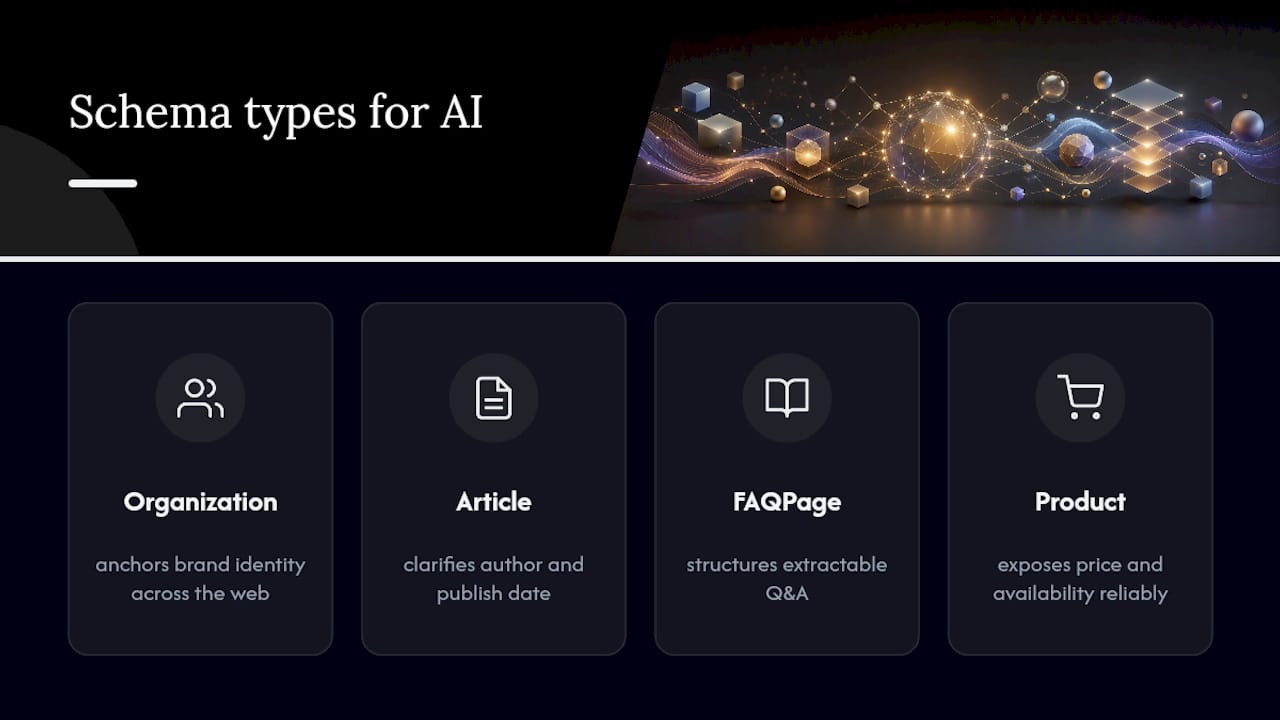
The highest-value schema types for AI search optimization tend to be Organization, Article, FAQPage, and Product, depending on the page type. Organization schema anchors your brand as a consistent entity across the web. Article schema clarifies authorship and publish dates, both of which factor into freshness signals AI systems weigh when choosing a source. Product schema gives clear pricing and availability data that’s far more reliable to cite than parsing that information out of body copy.
That said, schema is a supporting signal, not a replacement for clear content. As Google’s own documentation states, structured data is helpful but not required for generative AI features to understand and cite a page. A page with immaculate schema but a vague, unclear answer in the body text still won’t get cited reliably, because the model still has to parse the actual prose to generate a trustworthy response.
Treat schema as insurance, not strategy. Implement it correctly across your key page types, validate it with testing tools, and then put your real effort into writing content that’s specific enough to stand on its own without the markup.
What We’ve Learned Building AI Visibility for Client Sites
The gap between AI search optimization advice and actual results comes down to sequencing. Sites that fix retrieval and extractability first, before chasing entity signals or digital PR, see citation movement inside weeks. Sites that skip straight to outreach without an indexable, well-structured page underneath waste that outreach entirely.
The workflow that holds up: audit for retrieval blockers, rebuild lead paragraphs into genuine extractable answers, then measure citation rate against a fixed prompt set before touching anything else. It’s worth remembering that most businesses still see AI-driven channels contributing a modest share of revenue today. That’s a reason to build the foundation properly now, not a reason to skip it.
— Ruthwik
How Courimo Turns This Checklist Into Results
Courimo runs this exact program for clients who don’t have a spare development team or content unit to execute a 90-day plan alone. That’s the practical advantage: you get an SEO audit that flags retrieval blockers, a content team that rebuilds extractable answers across your cluster pages, and a technical fix list handed straight to your developer, or handled directly by ours.

The mapping is straightforward. Technical retrieval issues, crawlability, rendering, indexing, get resolved through Courimo’s SEO services. Cluster building and extractable content go through the same team. Entity and authority work, including digital PR and structured data implementation, rounds out the program. For a broader look at how content structure and modern search visibility connect, BabyLoveGrowth’s overview of generative search optimization is worth a read alongside this checklist.
The next step is simple: request a free SEO quote, and Courimo will audit your current retrieval eligibility, content structure, and entity signals, then hand back a prioritized plan built around where your site actually stands today.
Sources
- Optimizing your website for generative AI features on Google Search (Google Developers)
- AI search optimization survey (Search Engine Land)
- Content structuring and AI search (HubSpot)